



IL-2 Family Signaling Pathway
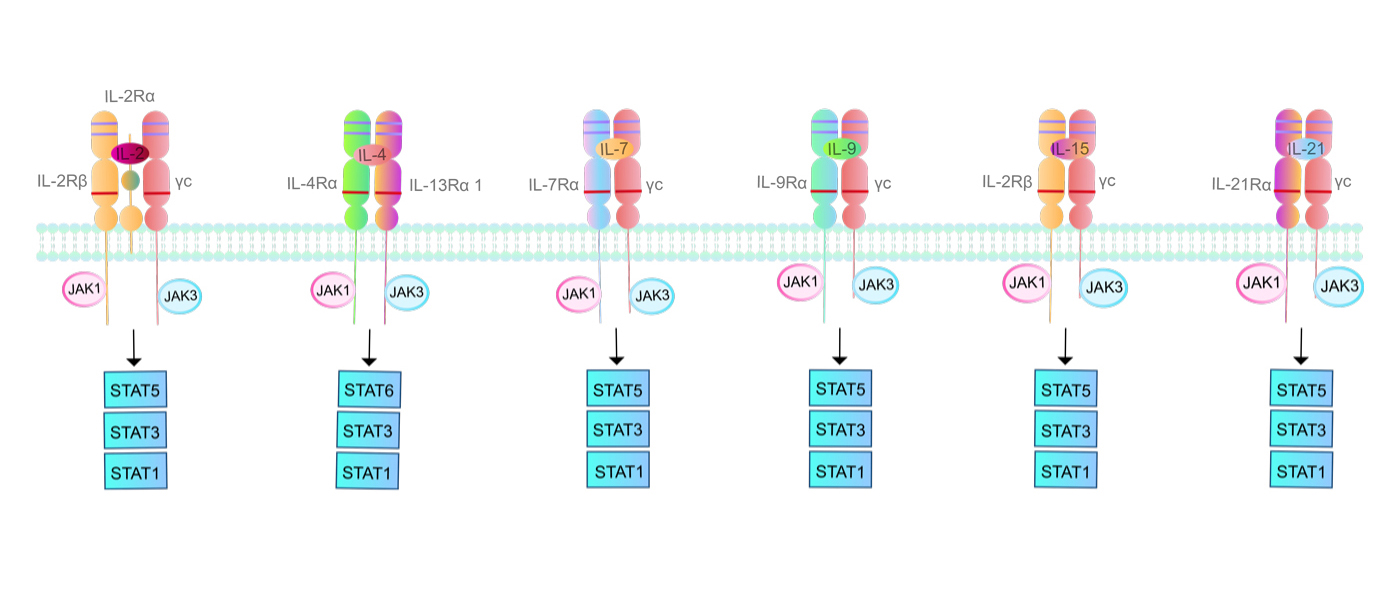
 IL-2Rβ
γc
IL-2Rα
IL-2
IL-4Rα
IL-13Rα1
IL-4
IL-7Rα
γc
IL-7
IL-9Rα
γc
IL-9
IL-2Rβ
γc
IL-15
IL-21Rα
γc
IL-21
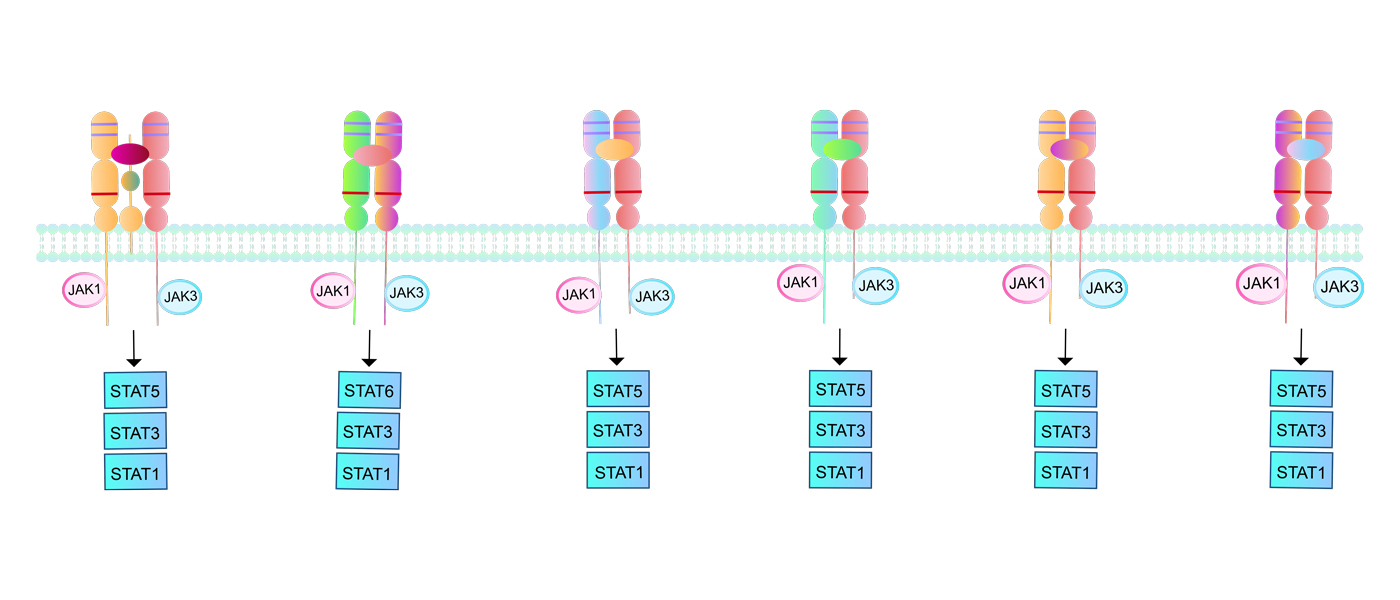
IL-2Rβ
γc
IL-2Rα
IL-2
IL-4Rα
IL-13Rα1
IL-4
IL-7Rα
γc
IL-7
IL-9Rα
γc
IL-9
IL-2Rβ
γc
IL-15
IL-21Rα
γc
IL-21
Background
The interleukin-2 (IL-2) family plays a central role in adaptive immune regulation and serves as a key complement to the IL-1 family, which primarily drives innate immunity. Members of this family—including IL-2, IL-4, IL-7, IL-9, IL-15, and IL-21—share a characteristic four-helix bundle structure. Their receptors consist of a common γ chain paired with cytokine-specific subunits, a design that ensures signaling specificity while enabling functional overlap across the family.
As the prototypical cytokine of this group, IL-2 exhibits a unique dual regulatory function: it promotes activation of effector T cells and NK cells while simultaneously expanding regulatory T cells (Tregs). This duality gives IL-2 a complex role in autoimmune diseases. Low-dose IL-2 selectively boosts Treg activity and suppresses autoimmune responses, and has already been applied clinically in conditions such as systemic lupus erythematosus and rheumatoid arthritis. In contrast, high-dose IL-2 activates effector T cells and can exacerbate tissue injury in diseases such as type 1 diabetes and multiple sclerosis.
Cytokines such as IL-4 and IL-13 also play important roles in allergy and autoimmunity. IL-4 is the master driver of Th2 differentiation and promotes IgE class switching in B cells, linking it closely to allergic diseases and certain autoimmune disorders such as autoimmune dermatitis. In systemic autoimmune diseases, IL-4 contributes to pathogenesis by modulating antibody responses and inflammatory polarization, and has been implicated in specific forms of autoantibody-mediated nephritis and vasculitis.
In summary, the IL-2 family profoundly shapes the onset and progression of autoimmune diseases by regulating both the magnitude and the quality of T-cell responses.
- IL-2 Family Signaling Pathway