Home PageProductsRecombinant ProteinsCAR Targets for Hematological Malignancies
CAR Targets for Hematological Malignancies
Chimeric antigen receptor T (CAR-T) cell therapies, following its regulatory approval, has been frequently considered a breakthrough therapy regarding hematological tumors. Currently, only CD19 and BCMA have been approved as targets against refractory large B-cell lymphoma. However, research has highlighted more than 30 other targets that has shown potential in combating other hematological malignancies.
Various species including human, mouse, monkey, rabbit, etc
High bioactivity verified by FACS/ELISA/SPR
Star Staining―Alexa Fluor™ 488/555/647, PE, APC, FITC-labels are available
Some products have been filed with FDA DMF to support your IND, NDA and BLA
Product List
To support the research and development of hematologic malignancy cell therapies, we have developed a wide series of targets including covering different species and fluorescent labeling types. These products can be used for immune screening, CAR detection and PK study to accelerate your cell therapy research.
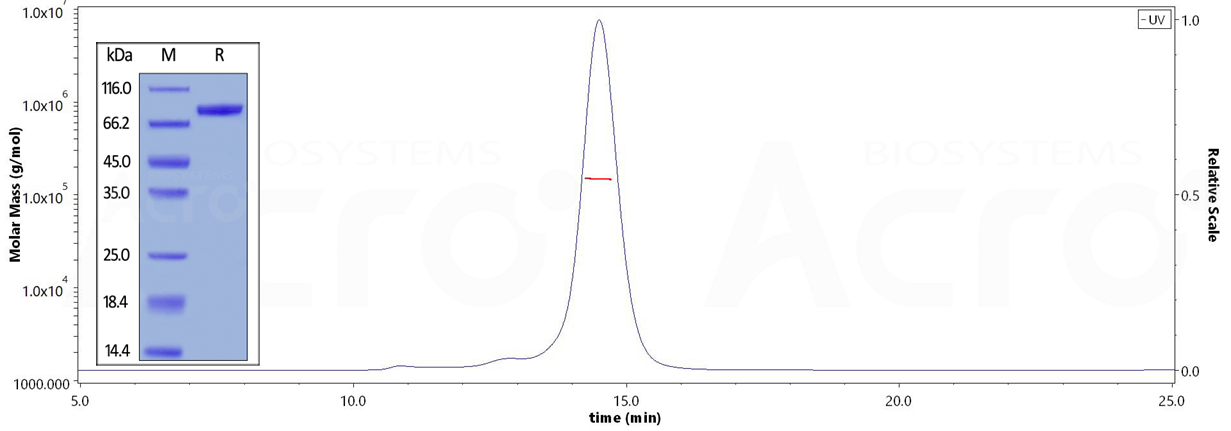
The purity of Human CD19 (20-291), Fc Tag, premium grade (Cat. No. CD9-H5251) is more than 90% and the molecular weight of this protein is around 130-160 kDa verified by SEC-MALS.
High Bioactivity
> High bioactivity verified by ELISA for early antibody screening
Immobilized Human / Cynomolgus / Rhesus macaque ROR1, Fc Tag (Cat. No. RO1-H5250) at 2 μg/mL (100 μL/well) can bind Anti-ROR1 Antibody, Human IgG1 with a linear range of 0.3-5 ng/mL (QC tested).
Immobilized Human Siglec-2, Fc Tag (Cat. No. CD2-H5253) at 2 μg/mL (100 μL/well) can bind Monoclonal Anti-Human Siglec-2 Antibody, Human IgG1 with a linear range of 2-62.5 ng/mL (QC tested).
Binding activity of FITC-Labeled Human BCMA and CD19 protein from two different vendors were evaluated by the FACS analysis. The result showed that ACRO's Star Staining FITC-Labeled Human BCMA (Cat. No. BCA-HF2H3) and CD19 (Cat. No. CD9-HF2H3) protein have a much higher binding activity than that of the other competitor.
5e5 of PBMCs were stained with AF555-Labeled Human CD19 (20-291), His Tag (Cat. No. CD9-HA2H7) and anti-CD3 antibody, washed and then analyzed with FACS. FITC signal was used to evaluate the expression of CD3+ T cells in PBMCs, and AF555 signal was used to evaluate the non-specific binding activity to PBMCs (QC tested).
Why has CAR-T therapy achieved remarkable success in hematologic malignancies?
CAR-T therapy has demonstrated outstanding efficacy in hematologic malignancies due to three key biological advantages. First, major targets such as CD19 and BCMA exhibit highly lineage-restricted expression, being primarily confined to B cells and plasma cells with minimal expression in normal tissues, thereby reducing the risk of on-target, off-tumor toxicity. Second, hematologic cancer cells reside in the blood, bone marrow, and lymphatic system, allowing CAR-T cells to directly access and eliminate target cells without encountering dense stromal barriers. Third, target antigen expression is generally homogeneous and stable, consistently reaching the threshold required for CAR-T activation and enabling sustained antitumor immune responses. Throughout CAR-T development, highly active and consistent target antigens are essential for generating reproducible results. ACROBiosystems provides rigorously quality-controlled recombinant CD19 and BCMA proteins with excellent batch-to-batch consistency, supporting CAR affinity characterization, positive clone screening, and functional potency assays to ensure reliable preclinical data.
Q
What are the most clinically validated and widely used CAR-T targets for hematologic malignancies?
CD19 and BCMA are currently the two most clinically validated CAR-T targets. CD19 is the benchmark target for B-cell acute lymphoblastic leukemia (B-ALL) and B-cell non-Hodgkin lymphoma (B-NHL), and serves as the basis for multiple approved CAR-T therapies. BCMA is the leading target for multiple myeloma and has transformed its treatment landscape. Other important targets include CD22 for patients relapsing after CD19-directed therapy, CD33, CD123, and CLL-1 for acute myeloid leukemia (AML), and CD7 for T-cell malignancies. ACROBiosystems offers a comprehensive portfolio of recombinant proteins covering all major hematologic malignancy targets, including CD19, BCMA, CD22, CD33, CD123, CLL-1, and CD7. Featuring high biological activity and excellent batch consistency, these products support the entire CAR-T development workflow from early target validation to preclinical studies.
Q
What is the primary cause of relapse after CAR-T therapy for hematologic malignancies?
Antigen escape is the leading cause of relapse following CAR-T therapy in hematologic malignancies. The strong immune selection pressure exerted by CAR-T cells enables tumor subpopulations with reduced or absent target antigen expression to survive and expand, ultimately resulting in disease recurrence. CD19 antigen loss is the most common relapse mechanism observed clinically. Additional factors, including CAR-T cell exhaustion, limited in vivo persistence, and local immunosuppressive microenvironments, further reduce treatment durability. Accurate assessment of antigen expression and the development of CAR constructs capable of overcoming antigen escape are therefore essential. ACROBiosystems' high-activity recombinant target proteins with native conformations facilitate precise evaluation of CAR recognition and support the development of multi-target strategies to improve resistance to relapse.
Q
What are the major challenges facing CAR-T development for hematologic malignancies?
Despite the commercial success of CAR-T therapy for hematologic malignancies, several important challenges remain. These include high relapse rates caused by antigen escape, progressive functional exhaustion of infused CAR-T cells, fratricide during CAR-T development for T-cell malignancies, and inherent toxicity associated with targets expressed on normal hematopoietic cells. Current research efforts focus on next-generation strategies such as gene-edited CAR-T cells, allogeneic off-the-shelf CAR-T therapies, and logic-gated multi-target CAR designs.
Q
What role do CAR target proteins play in CAR-T development, and how can high-quality target proteins be selected?
CAR target proteins are essential tools throughout the CAR-T development workflow, supporting CAR discovery, functional validation, and quality evaluation. During early-stage development, they enable scFv screening, CAR affinity optimization, and candidate selection. In functional studies, they support binding assays, flow cytometry analysis, and cytotoxicity evaluation. During clinical development, standardized target proteins facilitate assay establishment, batch consistency assessment, and quality control to ensure reliable and reproducible results.
High-quality CAR target proteins should meet three key criteria: native conformation to accurately mimic tumor antigens and enable precise CAR recognition; high biological activity and purity to minimize nonspecific binding and assay interference; and excellent batch-to-batch consistency to support long-term research and commercial quality control.
ACROBiosystems offers a comprehensive portfolio of 80+ CAR-T target proteins covering major hematologic and solid tumor targets. Rigorously validated for conformation, activity, and purity, these proteins provide native structure, high activity, and exceptional consistency to support CAR screening, functional evaluation, clinical testing, and commercial QC throughout the CAR-T development pipeline.




 Various species including human, mouse, monkey, rabbit, etc