


Product Details
Product Overview
To expedite in-process and lot-release testing, the Mycoplasma DNA Sample Preparation kit based on magnetic beads has been developed, offering a simple and convenient way to isolate mycoplasma DNA from biologic products. All handling and run times are 40-50 minutes.
Combined with Mycoplasma DNA Sample Preparation Kit, ACRO's mycoplasma Rapid Detection kit (OPA-S102) can sensitively and reliably detect mycoplasma contamination in biological products, meeting or exceeding the regulatory guidance of 10 CFU/mL.
Features
- High recovery: DNA recovery yields superior purity over column-based methods
- Better robustness: Tolerant to various matrices, high cell density (107 cells/mL), 10% DMSO, T/NK cell mediums, etc.
- High-quality: This kit is manufactured in ISO 13485 standard facility.
Application
The kit is used for extraction of mycoplasma DNA in cells and bioproduct media.
For use in quality control/manufacturing process only.
It is for research use only.
Fit different automated nucleic acid systems
We provided a program to fit KingFisher Flex 96 (ThemoFisher) for the SAFENSURE™ Mycoplasma DNA Sample Preparation Kit (Magnetic beads) to ensure running convenience.
DownloadTechnical Specifications
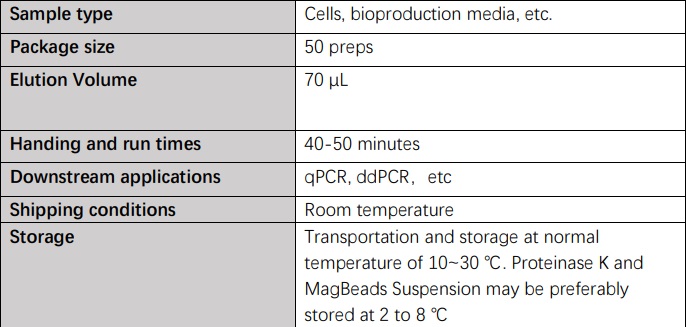
Materials Provided
IDComponentsSizeOPA-E101-01Buffer AL35 mLOPA-E101-02Proteinase K4 mLOPA-E101-03MagBeads Suspension (MB)1.4 mLOPA-E101-04CR Powder310 μgOPA-E101-05Buffer WA38 mLOPA-E101-06Buffer WB18 mLOPA-E101-07Buffer MEB4 mLOPA-E101-08Sample Dilution Buffer5 mLACRO Quality Management System
Customers Also Viewed
Customer Reviews Writing Reviews

FAQ
- product
Can lyophilized proteins remain stable during room-temperature shipping or temporary room-temperature exposure?
In general, lyophilized proteins remain stable during room-temperature shipping or temporary exposure to room-temperature conditions.
Many ACROBiosystems recombinant proteins are supplied in lyophilized (freeze-dried) form. The lyophilization process effectively removes moisture from the product, helping reduce degradation-related reactions and improve protein stability during transportation and storage.
To evaluate the stability of lyophilized proteins under normal temperature conditions, ACROBiosystems conducted a stability study on 11 representative lyophilized protein products at 37°C. The study demonstrated that these proteins maintained good quality stability after storage at 37°C for approximately 20 days. Based on these validation results, temporary room-temperature exposure during shipping or handling is generally not expected to have a significant impact on product quality or downstream application performance.
To ensure optimal long-term stability, products should be stored according to the storage conditions specified in the product Certificate of Analysis (COA) upon receipt.
Supporting Document


