



SAFENSURE™ Advanced Safety Testing Solution for Biologics
Biopharmaceutical safety testing is fundamental to ensuring product quality, patient safety, and regulatory compliance. As innovative biologics—including monoclonal antibodies, vaccines, cell therapies, and gene therapies—continue to advance, the industry demands higher standards for analytical sensitivity, testing efficiency, standardization, and method robustness. Conventional testing methods often struggle to meet the increasing demands for rapid turnaround, automation, and accelerated batch release. Next-generation testing technologies, such as recombinant reagents and nucleic acid amplification technology(NAT), offer enhanced sensitivity, testing efficiency, and strong alignment with regulatory requirements, providing efficient and reliable solutions for biopharmaceutical safety testing.

SAFENSURE™ is ACROBiosystems' dedicated brand for biopharmaceutical safety testing, providing reliable and regulatory-compliant solutions for critical safety quality control. Designed to support quality control across the biopharmaceutical lifecycle, SAFENSURE™ helps biopharmaceutical manufacturers improve testing efficiency, minimize quality risks, and strengthen quality assurance.
Built on internationally recognized pharmacopeial standards, including USP and EP, SAFENSURE™ integrates advanced technologies such as recombinant reagents and nucleic acid amplification technology (NAT) to provide reliable safety testing solutions. The portfolio supports quality control across R&D, process development, GMP manufacturing, and product release, addressing evolving safety testing needs with solutions for endotoxin, mycoplasma, sterility, and other critical safety testing applications.

Safety & Sustainability
Safe and reliable, eco-friendly, building a sustainable future

Regulatory Compliance
Aligned with global standards, supporting confident compliance

Accelerated Batch Release
Boost testing efficiency, accelerate your path to market
Endotoxin Detection Platform
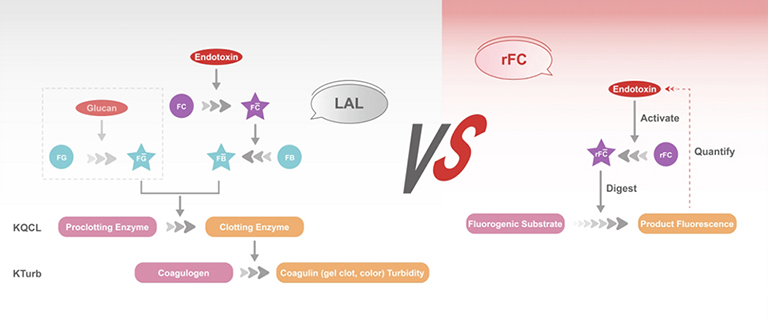
The recombinant Factor C (rFC) assay uses genetically engineered recombinant Factor C to bind and detect endotoxins with high sensitivity and specificity. Upon activation by endotoxin, the rFC cleaves a fluorogenic substrate, generating a fluorescence signal proportional to endotoxin levels.
Compared to conventional LAL assays, this kit provides improved accuracy, eliminates interference from Factor G pathways, and delivers more consistent, reproducible results aligned with global regulatory trends toward sustainability and animal-free testing.
Product List
| Cat. No. | Description | Size |
|---|---|---|
| RES-A056 | SAFENSURE™ Recombinant Factor C Endotoxin Detection Kit | 48/96 Tests |
| RES-A129 | LER Sample Dilution Buffer | (15 mL×5 bottles )/box |
| RES-A127 | Endotoxin-Free Glass Test Tubes | 2×boxes, (5 pieces×20 package)/box |
Star Product—Recombinant Factor C (rFC) Endotoxin Detection Kit (Cat. No. RES-A056)
High concordance with traditional LAL methods, third-party validation by Eurofins. Request Eurofins Validation Reports
Superior specificity: Effectively eliminates β-glucan interference.
High accuracy: Endotoxin standards traceable to USP Standard (Cat. No: 1235503).
Rapid results: Assay completion in under 2 hours.
Industry-leading sensitivity: Detects endotoxin from 0.005 - 5 EU/mL.
Excellent buffer compatibility for diverse assay systems.
Good inter batch consistency: Guaranteed by genetic recombination technology production.
Mitigates LER Challenges: Provides a dedicated solution for low endotoxin recovery (LER)-prone samples.
Rigorous method validation: Comprehensively evaluated for specificity, sensitivity, precision, accuracy, and suitability.
Validation Data

Different methods were used to detect endotoxin residues in four samples, and the values of this rFC method and LAL method were at the same level.

The kit is applicable in endotoxin detection of injectable drugs and some medium, such as Recombinant Human Interferon α-1b, Human insulin injection and different mediums. The results of the rFC method of this kit are compared with those of LAL method.

The rFC method was employed to detect endotoxin residues in β-glucan at concentrations of 10ug/mL and 1ug/mL. No non-specific signals were detected. In contrast, the dynamic chromogenic method used for β-glucan detection resulted in the detection of endotoxin and non-specific signals. This indicates that recombinant factor C does not react with β-glucan, demonstrating the good specificity of the rFC method.

Using Endotoxin (USP, Cat. No. U1235503) as the standard, the recovery rate of ACRO Kit standard is in the range of 50%-200%, which meets the requirements.
Mycoplasma Detection Platform
Mycoplasma contamination poses a critical risk during biologics production, particularly in processes such as cell isolation, modification, and expansion. To ensure the safety of the final product, mycoplasma must be completely excluded during release testing. ACROBiosystems’ SAFENSURE™ offers a comprehensive mycoplasma analytical reagents, including Mycoplasma DNA Sample Preparation Kit and Mycoplasma Rapid Detection Kit, developed to meet the requirements of European Pharmacopoeia Chapter 2.6.7,accelerating both biologics in-process monitoring and batch release.
Product List
| Cat. No. | Description | Size |
|---|---|---|
| OPE-32S | Automated Nucleic Acid Extraction System | / |
| OPA-E101 | SAFENSURE™ Mycoplasma DNA Sample Preparation Kit (Magnetic beads) | 50 Prep |
| OPA-S102 | SAFENSURE™ Mycoplasma Rapid Detection Kit (qPCR) | 50 Tests |
| OPA-R026 | Nuclease-Free Water | 10mL x 10bottle |
| OPA-R013 | 96 V-Bottom Deep-well Plate | 1 box |
| OPA-R014 | 8-Strip V-Bottom Tip Comb | 1 box |
Star Product — Mycoplasma Rapid Detection Kit (Cat. No. OPA-S102)
High Specificity: Target mycoplasma 16S rRNA with no cross-reactivity to other genera.
High Sensitivity: Meets regulatory standards of 10 CFU/mL.
Strong Compatibility: Suitable for complex matrices like high cell density samples and 10% DMSO.
Easy to use: Single-well assay format with built-in UNG and controls. results in 3 hours.
Reliable performance: Results align with culture-based methods; third-party validated by Eurofins.

Validation Data
| Number of Mollicutes detected with a Database match | |
|---|---|
| Genus | No. |
| Mycoplasma | >200 |
| Acholeplasma | 14 |
| Spiroplasma | 25 |
| Ureaplasma | 7 |
| ID | Mycoplasma Species | Compendia requirements (CFU/mL) | Results |
|---|---|---|---|
| 1 | Mycoplasma orale | 10 | 24/24 |
| 2 | Mycoplasma pneumoniae | 10 | 24/24 |
| 3 | Mycoplasma hyorhinis | 10 | 24/24 |
| 4 | Mycoplasma salivarium | 10 | 24/24 |
| 5 | Mycoplasma fermentans | 10 | 24/24 |
| 6 | Mycoplasma synoviae | 10 | 24/24 |
| 7 | Mycoplasma gallisepticum | 10 | 24/24 |
| 8 | Mycoplasma arginini | 10 | 24/24 |
| 9 | Acholeplasma laidlawii | 10 | 24/24 |
| 10 | Spiroplasma citri | 10 | 24/24 |
| Unrelated strain/Cell line | Ct Value | Result | |
|---|---|---|---|
| Streptococcus pneumoniae | Undetermined | Undetermined | 0/2 |
| Lactobacillus acidophilus | Undetermined | Undetermined | 0/2 |
| Staphylococcus epidermidis | Undetermined | Undetermined | 0/2 |
| Clostridium sporogenes | Undetermined | Undetermined | 0/2 |
| Clostridium acetobutylicum | Undetermined | Undetermined | 0/2 |
| CHO(106 cells/mL) | Undetermined | Undetermined | 0/2 |
| HEK293(106 cells/mL) | Undetermined | Undetermined | 0/2 |
| T cell(107 cells/mL) | Undetermined | Undetermined | 0/2 |
| Pichia pastoris | Undetermined | Undetermined | 0/2 |
| E.coli | Undetermined | Undetermined | 0/2 |

Sterility Detection Platform
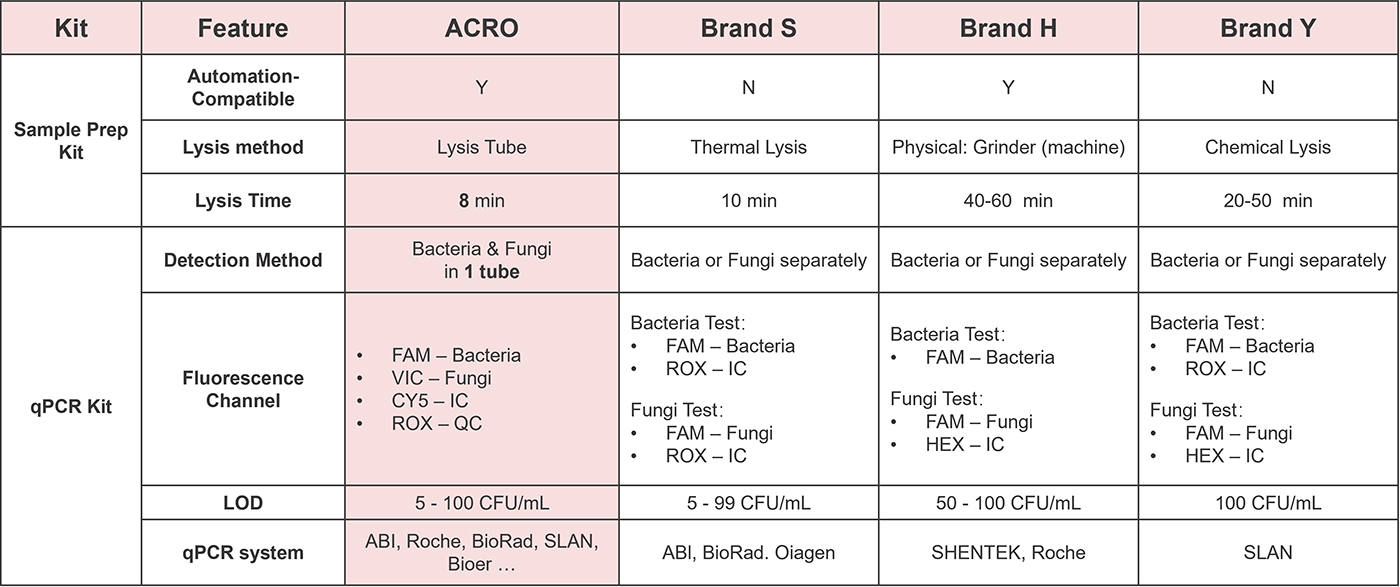
Nucleic Acid Testing (NAT) is a powerful approach for microbial detection, offering greater sensitivity and faster results than traditional culture methods. Validated to EP 2.6.1 and USP <71>, SAFENSURE™ Sterility Rapid Detection Kit (qPCR) delivers reliable test results in just 3 hours, enables simultaneous bacteria and fungi testing—revolutionizing in-process and lot-release testing with speed and reliability.
Paired with the SAFENSURE™ Sterility Sample Preparation Kit, the kits provide an end-to-end workflow from microbial nucleic acid isolation to detection. This minimizes handling errors, simplifies operations, and accelerates sterility testing with accurate, compliant results at lower cost.
Product List
| Cat. No. | Description | Size |
|---|---|---|
| OPE-32S | Automated Nucleic Acid Extraction System | / |
| OPA-E102 | SAFENSURE™ Sterility Sample Preparation Kit (Magnetic beads) | 16 preps |
| OPA-S103 | SAFENSURE™ Sterility Rapid Detection Kit (qPCR) | 50 Tests |
| OPA-R026 | Nuclease-Free Water | 10mL x 10bottle |
| OPA-R013 | 96 V-Bottom Deep-well Plate | 1 box |
| OPA-R014 | 8-Strip V-Bottom Tip Comb | 1 box |
Star Product — Sterility Rapid Detection Kit (Cat. No. OPA-S103)
Dual Detection: Identifies bacteria and fungi in one test, simplifying sterility testing workflows.
Strong Specificity: Multiple primers and probes ensure no cross-reactivity with related strains.
High Sensitivity: Detection sensitivity of <100 CFU/mL, meeting regulatory standards.
Convenient Operation: Single-well format with all essential components included for efficient testing.
Reliable Results: Demonstrates consistent performance with culture-based methods.
High Quality: Manufactured in ISO 13485 standards for reliable performance.

Validation Data
| Taxonomic Group | Validated Species | LOD(CFU/mL) | Positive Detection |
|---|---|---|---|
| Bacteria | Bacillus subtilis | 100 | 24/24 |
| Bacteroides fragilis | 100 | 24/24 | |
| Burkholderia cepacia | 100 | 24/24 | |
| Clostridium sporogenes | 100 | 24/24 | |
| Cutibacterium acnes | 100 | 24/24 | |
| Escherichia coli | 100 | 24/24 | |
| Micrococcus luteus | 100 | 24/24 | |
| Pseudomonas aeruginosa | 100 | 24/24 | |
| Staphylococcus aureus | 100 | 24/24 | |
| Streptococcus pyogenes | 100 | 24/24 | |
| Fungi | Aspergillus brasiliensis | 100 | 24/24 |
| Aspergillus niger | 100 | 24/24 | |
| Candida albicans | 100 | 24/24 |

The three fluorescent channels are independent and show no crosstalk, with a precision CV ≤ 0.25% (n=10).
Resources
Flyer—Recombinant Factor C (rFC) Endotoxin Detection Kit
Datasheet—Recombinant Factor C (rFC) Endotoxin Detection Kit
Flyer—Mycoplasma DNA Sample Preparation / Detection Kits
Datasheet—Mycoplasma Rapid Detection Kit (qPCR)
One-Stop SAFENSURE™ Safety Testing Services
resDetect™ CMC Manufacturing Process Residue Detection Solutions
E. coli resDNA Quantitative Kit (qPCR)
CHO resDNA Quantitation Kit (qPCR)


- Background
- Endotoxin Detection Platform
- Mycoplasma Detection Platform
- Sterility Detection Platform
- Resources