



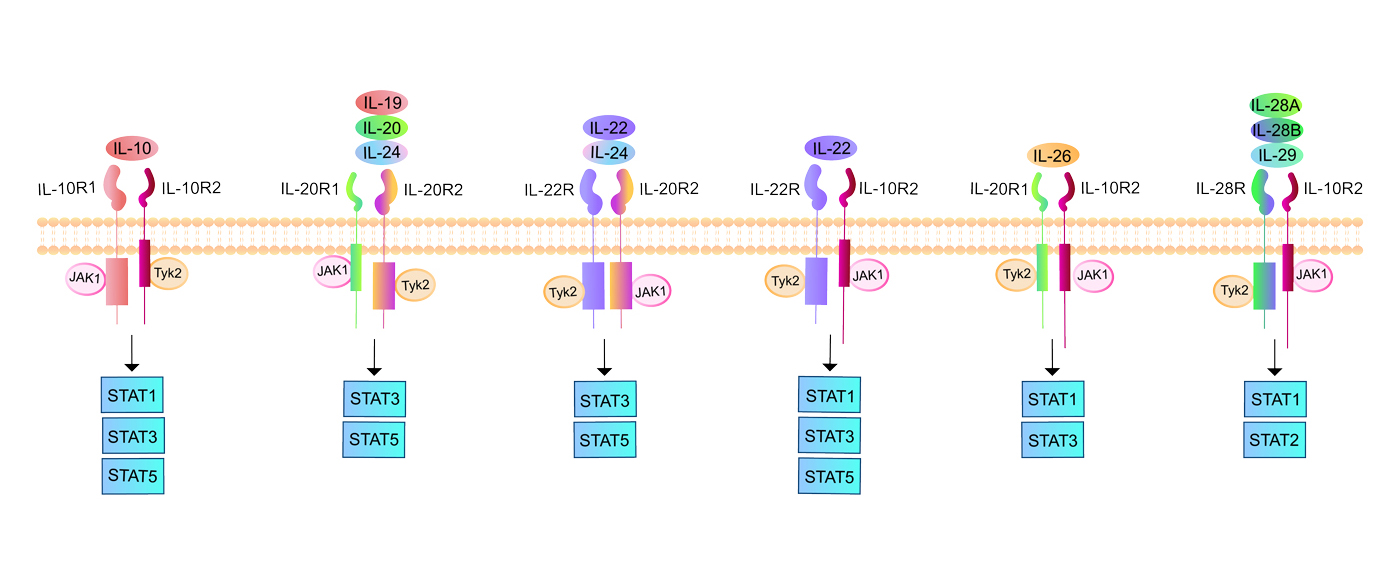
IL-10 Family Signaling Pathway
 IL-10R1
IL-10R2
IL-10
IL-20R1
IL-20R2
IL-19
IL-20
IL-24
IL-22R
IL-20R2
IL-22
IL-24
IL-22R
IL-10R2
IL-22
IL-20R1
IL-10R2
IL-26
IL-28R
IL-10R2
IL-28A
IL-28B
IL-29
IL-10R1
IL-10R2
IL-10
IL-20R1
IL-20R2
IL-19
IL-20
IL-24
IL-22R
IL-20R2
IL-22
IL-24
IL-22R
IL-10R2
IL-22
IL-20R1
IL-10R2
IL-26
IL-28R
IL-10R2
IL-28A
IL-28B
IL-29
Background
The interleukin-10 (IL-10) family plays a complex and critical role in maintaining immune homeostasis and regulating autoimmune responses. This family includes IL-10, IL-19, IL-20, IL-22, IL-24, IL-26, and others. While these cytokines share structural similarities and partially overlapping receptor subunits and downstream signaling pathways, they exhibit considerable functional diversity in immune regulation.
IL-10, the central member of this family, exerts potent anti-inflammatory effects via the Jak/Tyk–STAT pathway, suppressing activation of antigen-presenting cells and production of pro-inflammatory cytokines. Aberrant IL-10 expression is closely associated with disease activity in rheumatoid arthritis, inflammatory bowel disease, and systemic lupus erythematosus. However, its function is dualistic: in addition to limiting inflammation, IL-10 can promote B-cell activation and antibody production, potentially exacerbating disease progression in certain autoimmune conditions.
Other family members display even more nuanced functions. IL-22 plays a key role in tissue repair and barrier integrity, but its overexpression can drive inflammatory responses in psoriasis and rheumatoid arthritis. IL-20 and IL-24 contribute to psoriasis pathogenesis by promoting keratinocyte proliferation and differentiation.
Although preclinical studies suggest that modulating IL-10 family cytokines could provide novel therapeutic strategies for autoimmune diseases, no IL-10 family-targeted therapy has yet been approved clinically. Current research is focusing on more precise regulatory approaches, including tissue-specific delivery systems, receptor-selective modulators, and combination therapies with other cytokines. These strategies aim to overcome the functional complexity of IL-10 family cytokines and may ultimately open new avenues for the treatment of autoimmune diseases.
- IL-10 Family Signaling Pathway