E. coli Host Cell DNA Testing: Independent Eurofins Validation Demonstrates Reliable Residual DNA Quantification
 Publication Date:2026-07-20
 Page Views:165
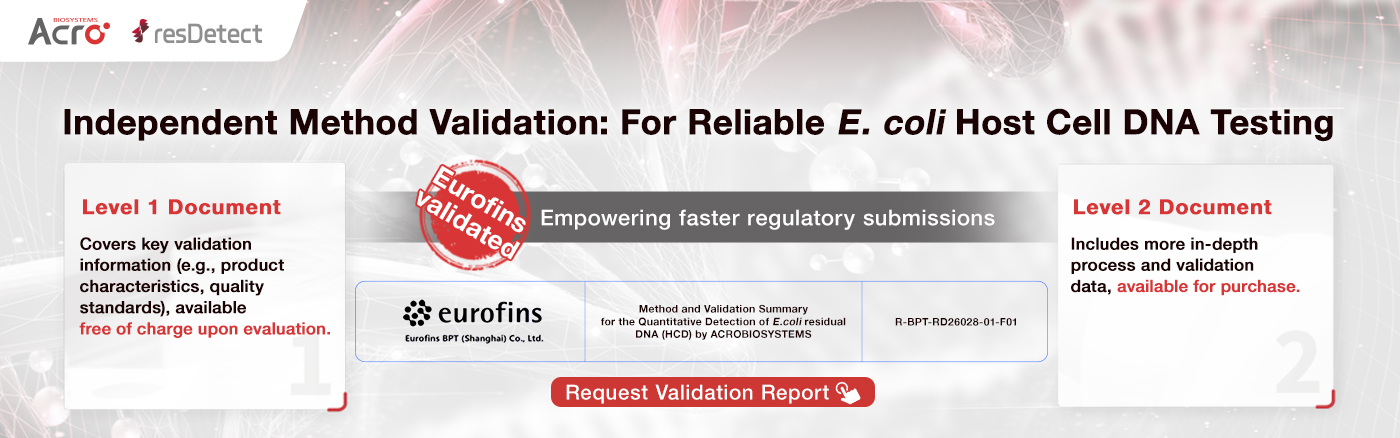
How the Eurofins-Validated resDetect™ qPCR Solution Supports Reliable Residual Host Cell DNA Analysis
As recombinant proteins, vaccines, plasmid DNA, and enzyme-based therapeutics continue to expand across the biopharmaceutical industry, Escherichia coli (E. coli) remains one of the most widely used prokaryotic expression systems. Its rapid growth, high protein expression yield, well-established fermentation processes, and cost efficiency make it an attractive manufacturing host for a broad range of biologics.
However, along with the target product, residual host cell-derived impurities—including host cell DNA (HCD)—may persist throughout downstream purification. Although purification processes substantially reduce these impurities, trace amounts of residual DNA can remain in the final product. Consequently, residual host cell DNA testing has become an essential component of biopharmaceutical quality control and a critical quality attribute (CQA) assessed during process development, process validation, lot release, and regulatory submissions.
As regulatory expectations continue to evolve, manufacturers increasingly require analytical methods that not only provide high sensitivity and specificity but also demonstrate robust analytical performance through comprehensive method validation. Independent third-party validation has therefore become an increasingly valuable approach for strengthening confidence in analytical methods and supporting global regulatory compliance.
Why Reliable E. coli Host Cell DNA Testing Matters
Residual host cell DNA testing is more than a routine release assay. It provides evidence that purification processes consistently remove process-related impurities while maintaining product safety.
For E. coli-derived biologics, residual DNA testing supports multiple stages of development, including:
- Process development and optimization
- Downstream purification evaluation
- Process validation
- GMP quality control
- Lot release testing
- Regulatory submissions
Because residual DNA concentrations often approach the lower limits of detection, analytical methods must combine:
- High specificity toward target host DNA
- Excellent sensitivity
- Broad quantitative range
- Robust reproducibility
- Stable performance across operators and instruments
These characteristics are typically demonstrated through comprehensive analytical method validation performed according to internationally recognized guidelines such as ICH Q2(R2), USP <1225> Validation of Compendial Procedures, and USP <509> Residual DNA Testing.
Independent Third-Party Validation Adds Confidence Beyond Internal Testing
Many analytical methods undergo internal qualification during development. However, independent third-party validation provides an additional level of confidence by demonstrating that assay performance can be reproduced under controlled laboratory conditions outside the manufacturer's own facilities.
For biopharmaceutical manufacturers, independently validated analytical methods offer several advantages:
- Increased confidence during supplier qualification
- Stronger technical support for IND, BLA, and global regulatory submissions
- Reduced implementation risk during technology transfer
- Greater assurance for routine GMP quality control laboratories
As global regulatory expectations continue to increase, third-party validation reports have become valuable technical evidence supporting analytical reliability.
Eurofins Validation of the resDetect™ E. coli Host Cell DNA Detection Solution
To further demonstrate analytical reliability, ACROBiosystems commissioned Eurofins BPT Shanghai to conduct an independent analytical method validation of its resDetect™ E. coli Host Cell DNA Detection Solution, consisting of the resDetect™ E. coli Host Cell DNA Detection Kit (Cat. No. OPA-O002) and the resDetect™ resDNA Sample Preparation Kit (Cat. No. OPA-R005). The validation confirmed excellent analytical performance across multiple critical parameters, providing additional confidence for biopharmaceutical quality control applications.
Comprehensive Validation Demonstrated Across Critical Performance Parameters
● Excellent Specificity
Specificity studies evaluated multiple negative matrices together with positive spike samples. Negative samples remained below acceptance thresholds, while positive controls were consistently detected. Spike recovery across different sample matrices ranged from 81.6% to 115.6%, demonstrating reliable discrimination of E. coli genomic DNA even in complex process matrices.
● High Sensitivity for Trace DNA Quantification
The validated assay achieved a Limit of Quantitation (LOQ) of 3 fg/μL, enabling reliable quantification of extremely low levels of residual host cell DNA. Such analytical sensitivity supports applications requiring trace-level DNA monitoring during downstream purification and final product release.
● Wide Linear Dynamic Range
The assay demonstrated excellent quantitative performance across concentrations ranging from: 3 fg/μL to 300 pg/μL with correlation coefficients: R² ≥ 0.999. The broad analytical range allows accurate quantification across diverse sample types encountered throughout bioprocess development and manufacturing.
● High Accuracy and Precision
Validation demonstrated excellent quantitative performance throughout the tested concentration range. Key results included:
- Spike recovery: 77.6–105.9%
- Intermediate precision (12 replicates across different instruments): RSD = 1.95%
These results indicate excellent repeatability and reproducibility for routine quantitative analysis.
● Robust Analytical Performance
Method robustness was evaluated using freeze-thaw testing and post-extraction sample stability studies. Results showed:
- Freeze-thaw precision: RSD = 1.52%
- DNA stability after extraction: RSD = 1.46%
Both values were substantially below the predefined acceptance criterion (RSD ≤15%), demonstrating excellent workflow stability suitable for routine laboratory operation.
● Summary of Eurofins Validation Results
| Validation Parameter | Result |
|---|---|
| Specificity | Spike recovery: 81.6–115.6% |
| LOQ | 3 fg/μL |
| Linear Range | 3 fg/μL–300 pg/μL |
| Linearity | R² ≥0.999 |
| Accuracy | Recovery: 77.6–105.9% |
| Intermediate Precision | RSD = 1.95% |
| Freeze-Thaw Robustness | RSD = 1.52% |
| DNA Stability | RSD = 1.46% |
Overall, the Eurofins validation confirmed that the analytical workflow met predefined acceptance criteria across all evaluated parameters, supporting reliable and reproducible residual E. coli host cell DNA quantification.
Supporting Regulatory Compliance with Reliable Analytical Data
As regulatory expectations continue to evolve, analytical methods are increasingly expected to demonstrate not only strong technical performance but also robust validation supported by scientifically sound evidence. Independent third-party validation provides additional confidence in assay reliability, helping biopharmaceutical manufacturers strengthen supplier qualification, support regulatory submissions, and reduce implementation risk. The successful Eurofins validation demonstrates that the resDetect™ E. coli Host Cell DNA Detection Solution delivers reliable analytical performance suitable for residual host cell DNA quantification throughout biologics development and GMP manufacturing.
Conclusion
Residual host cell DNA testing plays a critical role in ensuring the quality, consistency, and regulatory compliance of modern biopharmaceutical products. As analytical expectations continue to increase, independently validated methods provide greater confidence for both manufacturers and regulatory reviewers.
The independent Eurofins validation demonstrated that the resDetect™ E. coli Host Cell DNA Detection Solution delivers robust analytical performance across specificity, sensitivity, linearity, accuracy, precision, and robustness. By meeting predefined validation acceptance criteria, the workflow provides reliable support for residual host cell DNA quantification throughout process development, GMP quality control, lot release, and regulatory submissions.
As ACROBiosystems continues to expand its resDetect™ portfolio, the company remains committed to delivering scientifically validated, regulatory-aligned analytical solutions that help accelerate biologics development while strengthening quality assurance across the biopharmaceutical manufacturing lifecycle.

Related Recommendations
- resDetect™ CHO DNA Quantitative Kit (qPCR)
- resDetect™ Universal Protein A Quick ELISA Kit (Boiling-free)
- SAFENSURE™ Recombinant Factor C Endotoxin Detection Kit
- SAFENSURE™ Advanced Safety Testing Solution for Biologics
Frequently Asked Questions
Q1: Why is residual host cell DNA testing important?
A: Residual host cell DNA is considered a process-related impurity and a critical quality attribute (CQA) for many biologics. Monitoring residual DNA helps demonstrate purification efficiency, supports product safety, and contributes to regulatory compliance throughout process development and GMP manufacturing.
Q2: Why is E. coli host cell DNA difficult to quantify?
A: Residual E. coli DNA is typically present at extremely low concentrations after downstream purification. Accurate quantification therefore requires assays with high sensitivity, excellent specificity, broad linearity, and validated analytical performance to minimize false results.
Q3: Why is independent method validation valuable?
A: Independent third-party validation confirms that analytical performance can be reproduced outside the manufacturer's laboratory. It provides additional confidence for supplier qualification, technology transfer, regulatory submissions, and routine GMP quality control.
Q4: What analytical parameters were evaluated during the Eurofins validation?
A: The Eurofins validation assessed multiple critical analytical characteristics, including:
- Specificity
- Accuracy
- Precision
- Linearity
- Quantitative range
- Limit of Quantitation (LOQ)
- Robustness
 Popular ArticlesRelated RecommendationsPopular Events
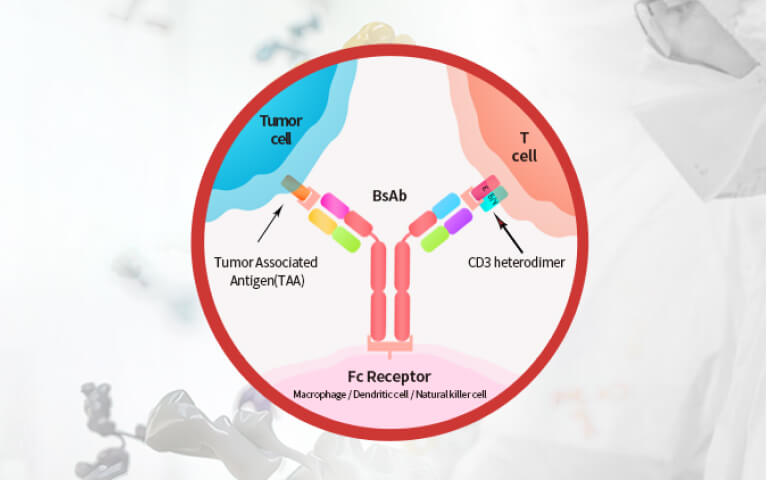 Beyond Bispecifics: How Multispecific Antibodies Are Breaking the Efficacy Ceiling2026-08-10Page Views:39
 Autoimmune Disease 3.0: Biomarkers Driving the Future of Precision Drug Development2026-08-06Page Views:44
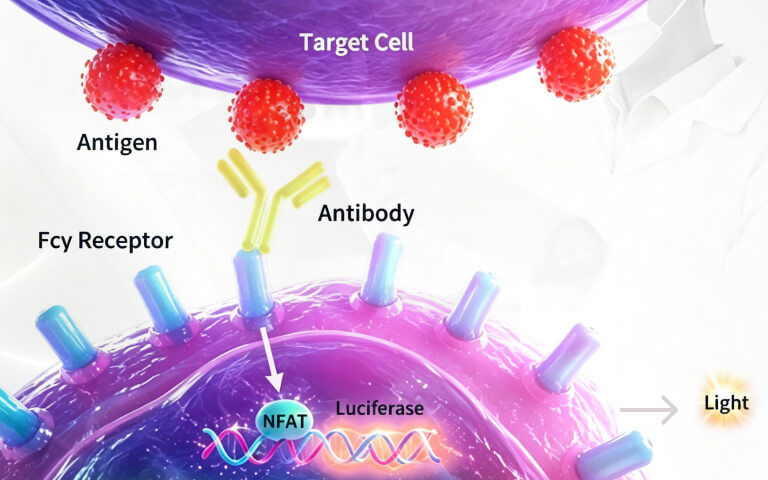 Application-Oriented Functional Cell Lines | Case Study Series2026-08-03Page Views:75
 AI-Assisted Bispecific Antibody Development: From Target Pairing Prediction to Experimental Validation2026-07-31Page Views:87
 The Brain's Fountain of Youth: How Modern Neuroscience Is Decoding Healthy Brain Aging2026-07-31Page Views:48





 Related Products