


 Aug 10, 2026
 Page Views:352


Twenty-eight years after the approval of the first monoclonal antibody, the FDA approved the first bispecific antibody (bsAb) in 2014. These engineered proteins have since delivered transformative clinical outcomes through dual-target synergy, continuously expanding therapeutic frontiers in oncology and immunology. However, dual-target intervention remains insufficient to address the multifactorial, multi-pathway drivers of complex diseases. This unmet clinical need has accelerated the translation of multispecific antibodies (msAbs) into clinical development. Far from being mere target aggregates, these molecules offer precisely defined stoichiometry and coordinated modulation of multiple signaling pathways¹. Such precision engineering enables biological effects unattainable by monospecific antibodies or even bispecifics—opening new avenues to overcome therapeutic bottlenecks in hematologic malignancies, solid tumors, and autoimmune diseases.
https://doi.org/10.1038/d41573-026-00106-5
Mechanisms and Design Strategies of Representative Multispecific Antibodies
Hematologic Malignancies: The "Dual-Lock" Paradigm Achieves 100% ORR
While bsAbs have demonstrated significant value in multiple myeloma (MM), antigen escape remains a primary driver of relapse. Trispecific antibodies (TsAbs) are now closing this escape route by simultaneously engaging multiple tumor-associated antigens.
- “Dual-Lock” Mechanism: Exemplified by Janssen’s JNJ-5322 (BCMA×GPRC5D×CD3), this molecule utilizes distinct binding domains to simultaneously engage BCMA and GPRC5D². This "dual-lock" approach ensures coverage of tumor cells expressing either antigen alone while effectively preventing resistance arising from antigen loss.
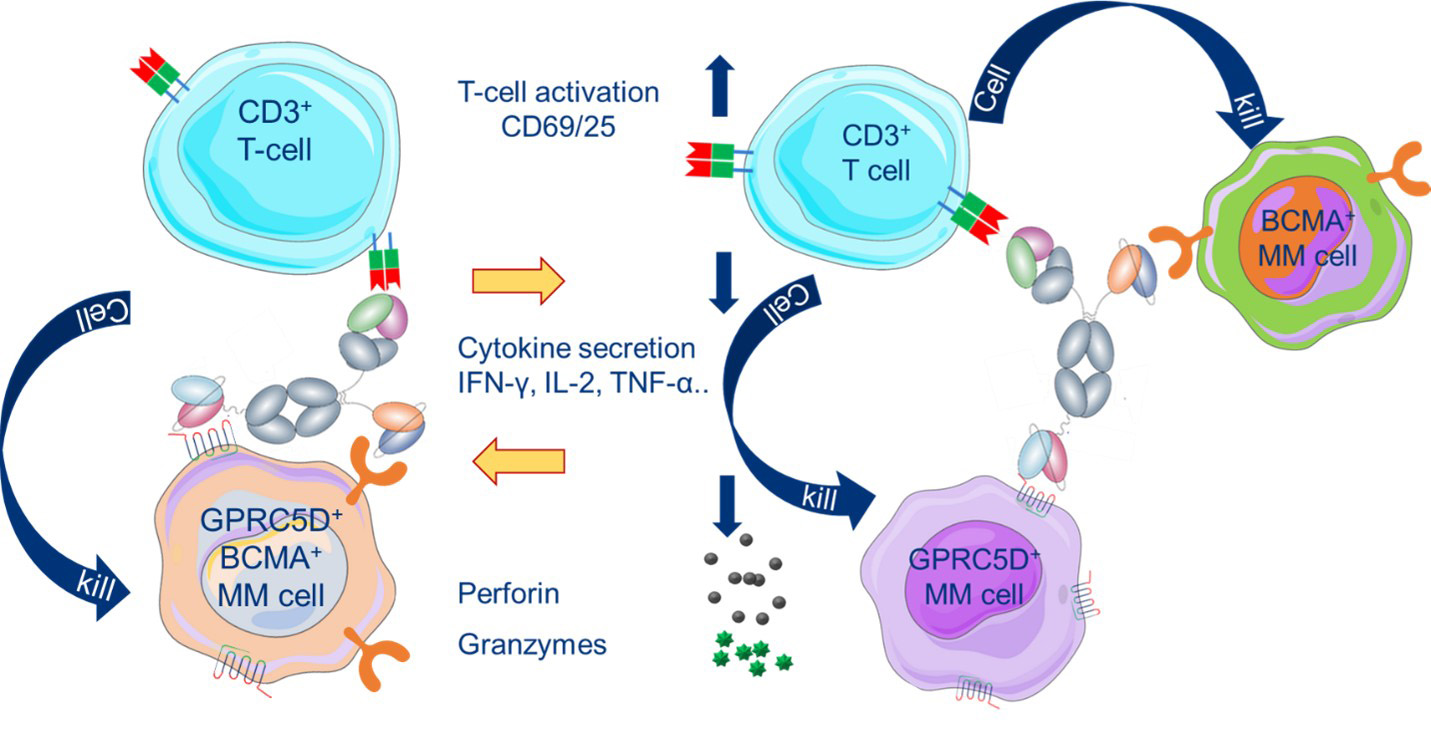
https://doi.org/10.1182/blood-2023-174941
Mechanism of action of JNJ-5322
- Clinical Progress: Updated Phase I data presented at ASH 2025 showed remarkable efficacy in relapsed/refractory MM (RRMM) patients naïve to prior BCMA or GPRC5D targeting. JNJ-5322 achieved a 100% objective response rate (ORR), 77.8% complete response or better (≥CR), and a 96.3% 12-month progression-free survival rate³ — among the most striking early-stage readouts yet seen in RRMM immunotherapy, and a candidate to become a next-generation option that pairs CAR-T-grade efficacy with bispecific-grade convenience.
Solid Tumors: Remodeling the "Cold" Tumor Microenvironment
The immunosuppressive microenvironment and heterogeneity of solid tumors have long limited antibody efficacy. TsAbs integrating checkpoint blockade and anti-angiogenesis now offer a novel solution.
- Overcoming Cold-Tumor Resistance: CStone Pharmaceuticals’ CS2009 (PD-1×VEGF×CTLA-4) leverages tri-specific synergy to reverse T-cell exhaustion, potentiate T-cell activation, and inhibit tumor angiogenesis. By reshaping the immunosuppressive microenvironment along multiple dimensions, it drives the conversion of “cold tumors” into “hot” ones.
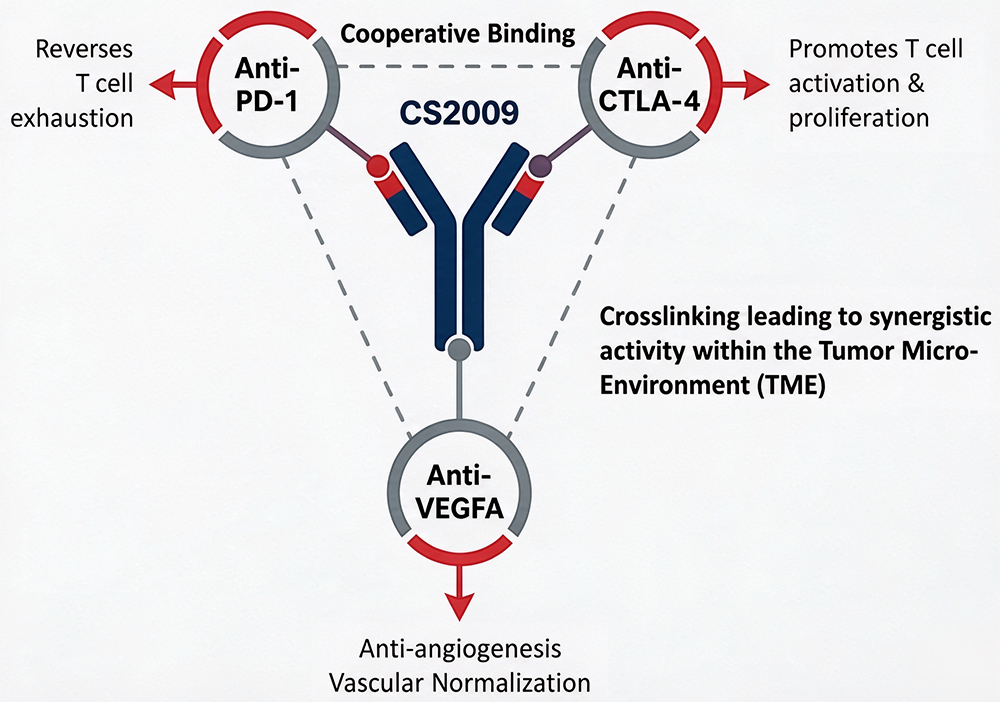
Mechanism of action of CS20094
- Clinical Progress: Phase I/II study presented at ASCO 2026 demonstrated encouraging antitumor activity across multiple solid tumors. In first-line PD-L1-high non-small cell lung cancer (NSCLC), single-agent CS2009 yielded an ORR of 81.3% and a disease control rate (DCR) of 100%. In PD-L1-negative/low squamous NSCLC treated with combination chemotherapy, the ORR reached 75.0%, including a striking 100% ORR in the PD-L1-null subgroup. Notably, promising activity was also observed in traditionally refractory indications such as mismatch repair-proficient/microsatellite-stable metastatic colorectal cancer (pMMR/MSS mCRC), validating the strategy of overcoming immune resistance via microenvironmental remodeling.
Autoimmune Disease: A Multi-Target “Bigger Mop” for Inflammation
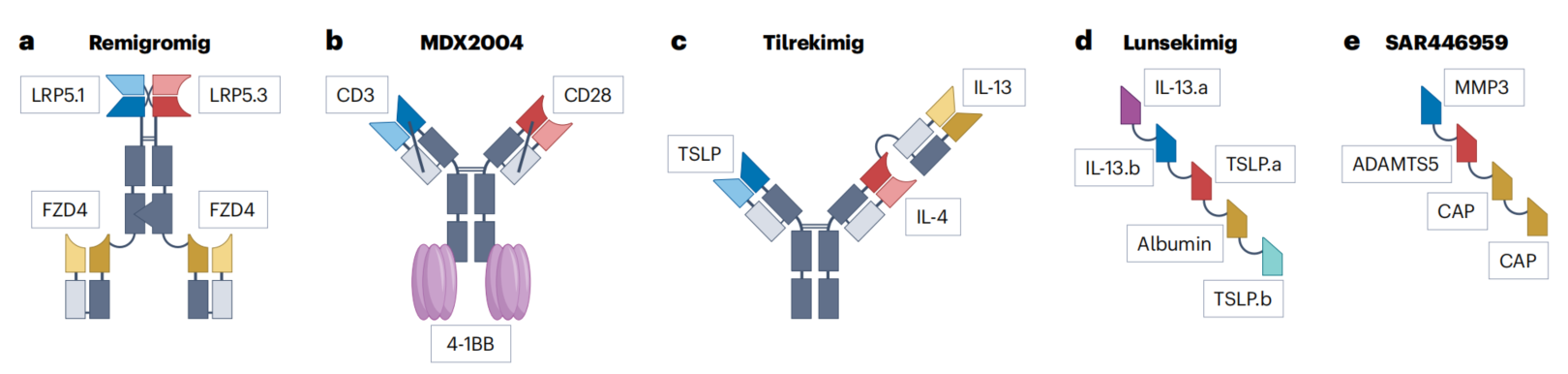
In autoimmune disorders, single-cytokine blockade often fails to reach maximal efficacy. TsAbs introduce a "bigger mop" strategy—enabling broader interception of inflammatory cascades¹.
- Comprehensive Inflammatory Suppression: Unlike monoclonal antibodies targeting only downstream signals, Pfizer’s Tilrekimig (IL-4×IL-13×TSLP) achieves broad-spectrum suppression of type 2 inflammation by concurrently blocking mid- and downstream effectors (IL-4/IL-13) and the upstream inducer (TSLP).
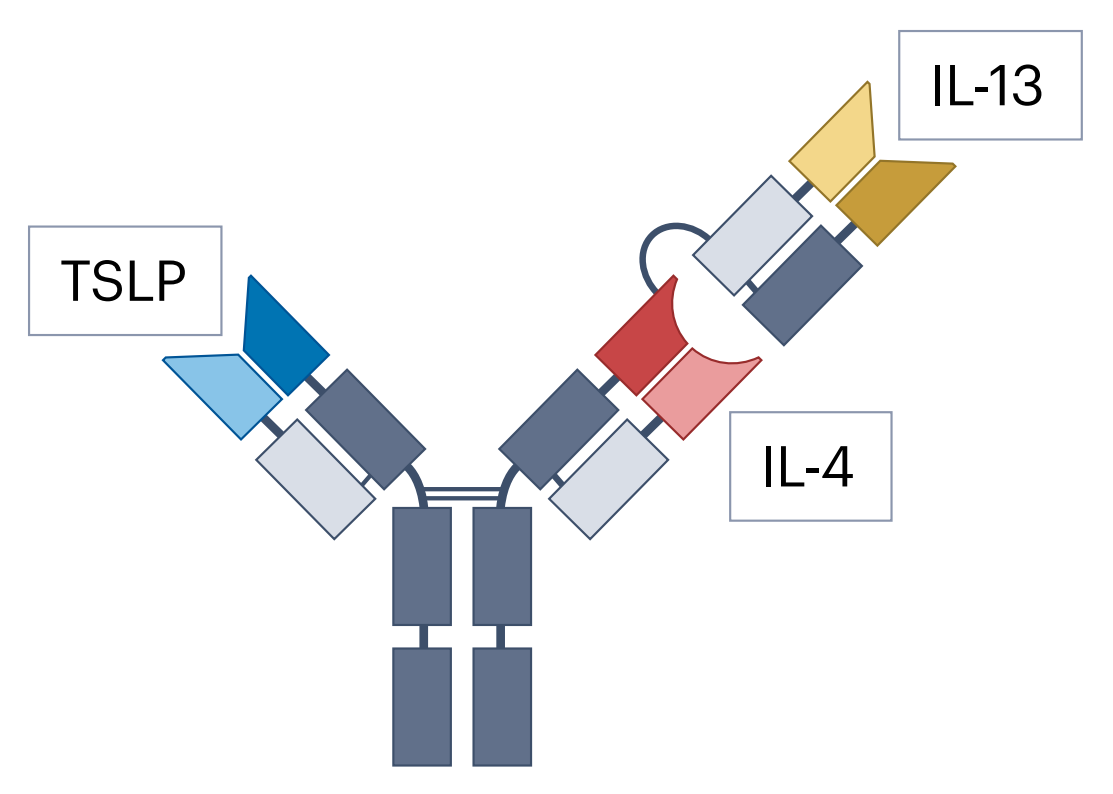
https://doi.org/10.1038/d41573-026-00106-5
Mechanism of action of Tilrekimig
- Clinical Progress: Positive Phase II results announced in 2026 met the primary endpoint, with all dose cohorts demonstrating statistically significant improvements in EASI-75 response rates at week 16 alongside favorable tolerability. Based on these findings, Pfizer has advanced Tilrekimig into Phase III development to further validate the "upstream + downstream" synergistic blockade in type 2 inflammatory diseases⁵.
Conclusion: Accelerating the Multispecific Era with Advanced Development Tools
The evolution from bispecific to multispecific antibodies marks a paradigm shift—from dual-target synergy toward precise, multiplexed pathway regulation. Whether addressing antigen escape in hematologic malignancies, reshaping the immune microenvironment of solid tumors, or achieving comprehensive control of autoimmune inflammation, msAbs represent a pivotal step forward in breaking through existing therapeutic ceilings.
To support msAb development across the entire workflow, we provide a comprehensive portfolio of high-quality target proteins, functional cell lines, TCR-CD3 complexes, and analytical services. Our solutions empower researchers from early discovery and candidate screening to functional validation, quality control, and translational research.
FAQ
Q1: Why are multispecific antibodies becoming the next major direction beyond bispecific antibodies?
A: Unlike bispecific antibodies, multispecific antibodies are designed to engage three or more targets or biological pathways within a single molecule. This enables coordinated regulation of complex disease mechanisms, including antigen heterogeneity, compensatory signaling, and immune suppression, which are often difficult to overcome with dual-target approaches alone. As antibody engineering technologies continue to advance, multispecific formats are becoming increasingly feasible for clinical development. Current research is focused not only on identifying effective target combinations, but also on optimizing molecular architecture, developability, pharmacokinetics, and safety to maximize therapeutic benefit.
Q2: Why are hematologic malignancies considered an ideal starting point for multispecific antibodies?
A: Hematologic malignancies were among the first diseases to demonstrate the clinical potential of multispecific antibodies because immune effector cells and tumor cells naturally circulate within the same environment, facilitating immune cell engagement. In addition, many blood cancers express well-characterized surface antigens that can be targeted simultaneously to reduce antigen escape. Current research is expanding from dual-target recognition toward multi-antigen strategies designed to improve tumor coverage, prolong response durability, and reduce relapse driven by heterogeneous antigen expression.
Q3: Why is multispecific antibody development more challenging in solid tumors?
A: Unlike hematologic malignancies, solid tumors present multiple barriers that limit therapeutic efficacy, including heterogeneous antigen expression, poor immune-cell infiltration, dense stromal tissue, and an immunosuppressive tumor microenvironment. As a result, multispecific antibodies for solid tumors are increasingly designed to combine complementary mechanisms, such as immune checkpoint blockade, T-cell recruitment, and modulation of the tumor microenvironment. The goal is not only to eliminate tumor cells directly but also to remodel the local immune landscape and achieve more durable antitumor responses.
Q4: Why are multispecific antibodies attracting growing interest in autoimmune diseases?
A: Autoimmune diseases are driven by interconnected inflammatory pathways rather than a single cytokine or signaling molecule. Blocking one inflammatory mediator may leave alternative pathways active, limiting long-term disease control. Multispecific antibodies offer the opportunity to simultaneously inhibit multiple complementary cytokines or immune regulators, enabling broader and potentially more durable suppression of pathological inflammation. This strategy is being actively explored in diseases such as atopic dermatitis, psoriasis, and inflammatory bowel disease, where multiple immune pathways contribute to disease progression.
Q5: Why is affinity optimization particularly important for multispecific T-cell engagers?
A: For multispecific T-cell engagers (TCEs), therapeutic activity depends on achieving a careful balance between potent immune activation and acceptable safety. Excessively strong CD3 binding may induce widespread T-cell activation and cytokine release, while overly weak binding can compromise immune synapse formation and reduce tumor cell killing. Affinity must therefore be optimized together with the affinities of the additional tumor-targeting arms, as well as their spatial arrangement and valency. Rather than maximizing the affinity of individual targets, successful multispecific TCE design aims to achieve coordinated target engagement that delivers effective antitumor activity with controlled immune activation.
Reference
1. Mullard A. Can multispecific biologics break the efficacy ceiling?[J]. Nature reviews. Drug Discovery, 2026, 25(7): 497-500. https://doi.org/10.1038/d41573-026-00106-5
2. Pillarisetti R, Yang D, Yao J, et al. Characterization of JNJ-79635322, a novel BCMAxGPRC5DxCD3 T-cell redirecting trispecific antibody, for the treatment of multiple myeloma[J]. Blood, 2023, 142: 456. https://doi.org/10.1182/blood-2023-174941
3. Krishnan A, Kaiser M, Popat R, et al. Updated efficacy and safety results of JNJ-5322, a novel, next-generation BCMA× GPRC5D× CD3 trispecific antibody, in patients with Relapsed/Refractory multiple myeloma[J]. 2025. https://doi.org/10.1182/blood-2025-4042
4. https://www.cstonepharma.com/en/uploads/2026/06/178027410395545.pdf
5. https://www.pfizer.com/news/press-release/press-release-detail/pfizers-phase-2-study-trispecific-antibody-positive