How Recombinant Factor C Is Transforming Endotoxin Testing Across Pharmaceutical Manufacturing
 Publication Date:2026-07-13
 Page Views:4452
Free Sample of Recombinant Factor C Endotoxin Detection Kit (RES-A056) Available Now!
Introduction
Bacterial endotoxin testing remains one of the most critical quality control requirements throughout pharmaceutical manufacturing. From raw material qualification to final product release, manufacturers must demonstrate that injectable drugs, biologics, vaccines, cell therapies, gene therapies, and medical devices meet stringent endotoxin limits to protect patient safety.
For decades, the Limulus Amebocyte Lysate (LAL) assay has been the industry standard for endotoxin detection. However, increasing emphasis on analytical specificity, lot-to-lot consistency, regulatory modernization, and environmental sustainability has accelerated the adoption of Recombinant Factor C (rFC) technology.
Today, recombinant Factor C is no longer viewed simply as an alternative assay—it is becoming a strategic platform for modern pharmaceutical quality control. This article explores how rFC technology works, why it is replacing traditional endotoxin testing methods, and where it delivers the greatest value across pharmaceutical manufacturing.
Why Endotoxin Testing Is Critical Throughout Pharmaceutical Manufacturing
Endotoxins are lipopolysaccharides (LPS) found in the outer membrane of Gram-negative bacteria. Even trace levels can induce fever, systemic inflammatory responses, septic shock, and potentially fatal complications when introduced into the bloodstream.
Because endotoxins are heat-stable and difficult to eliminate once contamination occurs, pharmaceutical manufacturers rely heavily on preventive monitoring and sensitive analytical testing throughout manufacturing.
Bacterial Endotoxin testing(BET) plays an essential role in:
• Raw material qualification
• Water system monitoring
• In-process manufacturing control
• Equipment cleaning validation
• Final product release
• Medical device quality assurance
As biologics become increasingly complex, analytical methods with higher specificity and robustness are becoming essential for reliable quality control.
Why the Industry Is Moving Beyond Traditional LAL Testing
• Dependence on Horseshoe Crab Resources: LAL reagents are produced from horseshoe crab blood, creating supply chain challenges while raising increasing concerns regarding biodiversity conservation and sustainable manufacturing.
• Biological Variability: Because LAL reagents originate from biological materials, batch-to-batch variability may influence assay consistency, requiring extensive reagent qualification and routine verification.
• Non-Specific Activation: Traditional LAL assays may respond not only to bacterial endotoxins but also to β-glucans, potentially generating false-positive results unless appropriate controls are incorporated.
• Increasing Regulatory Expectations: Modern pharmaceutical quality systems emphasize analytical methods that demonstrate higher specificity, improved reproducibility, and standardized manufacturing processes.
These challenges have accelerated interest in recombinant technologies capable of delivering equivalent or superior analytical performance.
What Is Recombinant Factor C Technology?
Recombinant Factor C technology reproduces the first step of the horseshoe crab coagulation cascade using genetically engineered recombinant proteins rather than animal-derived lysate.
When bacterial endotoxin binds recombinant Factor C, the enzyme becomes activated and initiates a fluorogenic reaction. Fluorescence intensity is proportional to endotoxin concentration, allowing highly sensitive quantitative analysis.
Unlike traditional LAL assays, rFC measures only the specific interaction between endotoxin and Factor C, eliminating interference from other coagulation factors.
This simplified reaction mechanism improves assay specificity while reducing biological variability.
Key Advantages of Recombinant Factor C
- Higher Analytical Specificity
Because recombinant Factor C directly recognizes endotoxin, it avoids activation by β-glucans that may interfere with traditional LAL assays. This improves confidence when testing complex biological samples.
- Excellent Lot-to-Lot Consistency
Recombinant production enables tightly controlled manufacturing processes, resulting in highly consistent reagent performance across production lots.
This consistency simplifies method validation and long-term quality management.
- High Sensitivity
Modern rFC assays routinely achieve detection limits as low as 0.005 EU/mL, supporting applications requiring highly sensitive endotoxin monitoring throughout pharmaceutical production.
- Sustainable Manufacturing
Unlike animal-derived LAL reagents, recombinant Factor C eliminates dependence on horseshoe crab harvesting, aligning with pharmaceutical sustainability initiatives and ESG objectives.
Applications of Recombinant Factor C Across Pharmaceutical Manufacturing
Rather than serving only as a finished product test, recombinant Factor C provides value throughout the entire manufacturing lifecycle.
1. Raw Material Qualification
Raw materials represent one of the earliest opportunities to control endotoxin risk.
Testing incoming buffers, media, excipients, plasma-derived materials, and process intermediates allows manufacturers to identify contamination before production begins, reducing downstream quality risks.
2. Water System Monitoring
Purified Water (PW) and Water for Injection (WFI) systems require continuous microbiological control.
Rapid and sensitive endotoxin monitoring helps verify system performance while supporting routine environmental monitoring programs.
3. In-Process Manufacturing Control
During upstream and downstream manufacturing, endotoxin contamination may originate from equipment, filters, chromatography resins, or process fluids.
Routine monitoring enables early detection, allowing corrective actions before contamination affects multiple manufacturing batches.
4. Cleaning Validation
Residual endotoxins remaining after equipment cleaning represent a significant quality risk.
Recombinant Factor C assays provide sensitive verification that cleaning procedures effectively remove endotoxin contamination from manufacturing equipment and production lines.
5. Final Product Release
Before commercial release, injectable drugs, vaccines, monoclonal antibodies, recombinant proteins, and advanced therapy medicinal products must comply with pharmacopeial endotoxin limits.
The high specificity and reproducibility of rFC assays support reliable batch-release decisions while reducing analytical uncertainty.
Regulatory Acceptance Is Accelerating Global Adoption
One of the most significant developments driving rFC adoption is expanding regulatory recognition.
Both the United States Pharmacopeia (USP) and the European Pharmacopoeia (Ph. Eur.) now recognize recombinant Factor C as a compendial bacterial endotoxin testing method, reflecting growing confidence in its analytical performance and suitability for pharmaceutical quality control.
This regulatory evolution allows manufacturers to modernize endotoxin testing strategies while supporting global regulatory submissions and lifecycle management.
For multinational pharmaceutical companies, harmonized implementation of rFC can improve standardization across manufacturing sites and reduce dependence on animal-derived reagents.
The Future of Endotoxin Testing
As biologics, cell therapies, gene therapies, and complex injectable medicines continue to expand, quality control laboratories require analytical technologies that combine sensitivity, specificity, consistency, and sustainability.
Recombinant Factor C addresses these requirements by offering:
• Animal-free reagent production
• High analytical specificity
• Excellent manufacturing consistency
• Regulatory acceptance
• Scalable implementation across pharmaceutical workflows
Rather than representing simply another endotoxin assay, recombinant Factor C is increasingly becoming a foundational technology supporting next-generation pharmaceutical quality systems.
For manufacturers seeking to improve analytical robustness while advancing sustainability objectives, rFC offers a scientifically sound and future-ready approach to bacterial endotoxin testing.
ACROBiosystems Recombinant Factor C Endotoxin Detection Kit
The Recombinant Factor C Endotoxin Detection Kit (Cat. NO. RES-A056) from ACROBiosystems, developed using genetic engineering, offers a rapid and effective method to detect bacterial endotoxins in samples. The endotoxin standards in the kit are strictly aligned with USP standards (Cat. No. U1235503) and China’s bacterial endotoxin working standards (No. 150601), ensuring high sensitivity, specificity, and consistency across batches. This kit is designed to meet the stringent quality control requirements of the pharmaceutical, medical device, and biopharmaceutical industries.
Verification Data – High Accuracy and Traceable Standards
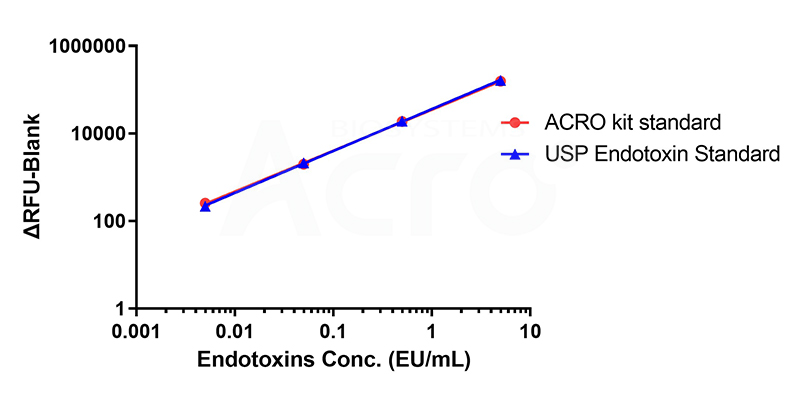
Using endotoxin (USP, Cat. No. U1235503) as the standard, the recovery rate of the ACRO Kit standard falls within the 50%-200% range, meeting regulatory requirements.

FAQ
Q1: Can recombinant Factor C replace traditional LAL assays?
A: Major pharmacopoeias now recognize recombinant Factor C as a compendial bacterial endotoxin testing method. However, implementation should follow applicable regulatory expectations and demonstrate method suitability for the intended product and manufacturing process.
Q2: Why is recombinant Factor C more specific than traditional LAL assays?
A: Unlike conventional LAL reagents, recombinant Factor C contains only the endotoxin-responsive protein responsible for recognizing lipopolysaccharide (LPS). Because it excludes other components of the horseshoe crab coagulation cascade, such as Factor G, rFC minimizes β-glucan interference and provides greater analytical specificity for bacterial endotoxin testing.
Q3: Which pharmaceutical applications benefit most from recombinant Factor C testing?
A: Recombinant Factor C is widely used for bacterial endotoxin testing of raw materials, purified water and Water for Injection (WFI), in-process samples, cleaning validation, injectable drugs, biologics, vaccines, recombinant proteins, cell and gene therapies, plasma-derived products, and medical devices.
Popular Products
> Mycoplasma Rapid Detection Kit
> Host DNA Residue Detection Kit
> Cytokines/Antibodies Residue Detection Kit
> Protein A Residue Detection Kit
Endotoxin Detection Insights Series
• Part 1: Strategies for Mitigating β-Glucan Interference in Endotoxin Detection
• Part 6: A Comprehensive Guide to Endotoxin Testing: Ensuring Precision Throughout the Process
• Part 7: Interfering Factors in Endotoxin Testing and an In-Depth Analysis of rFC Technology
Reference
1. Xu, Chao-sheng, and Wu, Shao-hai. "Application Prospects of Recombinant Factor C Method in Bacterial Endotoxin Detection for Medical Devices."
2. National Medical Device Quality Control Laboratory (Guangzhou, China, 510663).
 Popular ArticlesRelated RecommendationsPopular Events
 AI-Assisted Bispecific Antibody Development: From Target Pairing Prediction to Experimental Validation2026-07-31Page Views:51
 The Brain's Fountain of Youth: How Modern Neuroscience Is Decoding Healthy Brain Aging2026-07-31Page Views:18
 In Vivo CAR-T Therapy: Next-Generation CAR-T Cell Engineering and Gene Delivery Advances2026-07-29Page Views:45
 A Comprehensive Guide to Sterility Testing in Biopharmaceutical Manufacturing: From Compendial Methods to qPCR-Based Rapid Testing2026-07-27Page Views:65
 Biomarkers: Enabling Precision Assessment of Cardio-Kidney-Metabolic (CKM) Syndrome2026-07-24Page Views:96





 Related Products