Save Product

Product Details
Synonyms
CCL1, I-309, C-C motif chemokine 1
Source
Human CCL1 Protein, Tag Free (CC1-H5213) is expressed from human 293 cells (HEK293). It contains AA Lys 24 - Lys 96 (Accession # P22362-1).
Predicted N-terminus: Lys 24
Request for sequenceMolecular Characterization
Other Tags and Version Biotin & Other Labeled Version
This protein carries no "tag".
The protein has a calculated MW of 9.2 kDa. The protein migrates as 12-15 kDa when calibrated against Star Ribbon Pre-stained Protein Marker under reducing (R) condition (SDS-PAGE) due to glycosylation.
Endotoxin
Less than 1.0 EU per μg by the LAL method / rFC method.
Purity
>90% as determined by SDS-PAGE.
>90% as determined by SEC-MALS.
Formulation
Lyophilized from 0.22 μm filtered solution in PBS, pH7.4 with trehalose as protectant.
Contact us for customized product form or formulation.
Reconstitution
Please see Certificate of Analysis for specific instructions.
For best performance, we strongly recommend you to follow the reconstitution protocol provided in the CoA.
Storage
For long term storage, the product should be stored at lyophilized state at -20°C or lower.
Please avoid repeated freeze-thaw cycles.
This product is stable after storage at:
- -20°C to -70°C for 12 months in lyophilized state;
- -70°C for 3 months under sterile conditions after reconstitution.
ACRO Quality Management System
Customers Also Viewed
Performance Data
SDS-PAGE

Human CCL1 Protein, Tag Free on SDS-PAGE under reducing (R) condition. The gel was stained with Coomassie Blue. The purity of the protein is greater than 90% (With Star Ribbon Pre-stained Protein Marker).
SEC-MALS
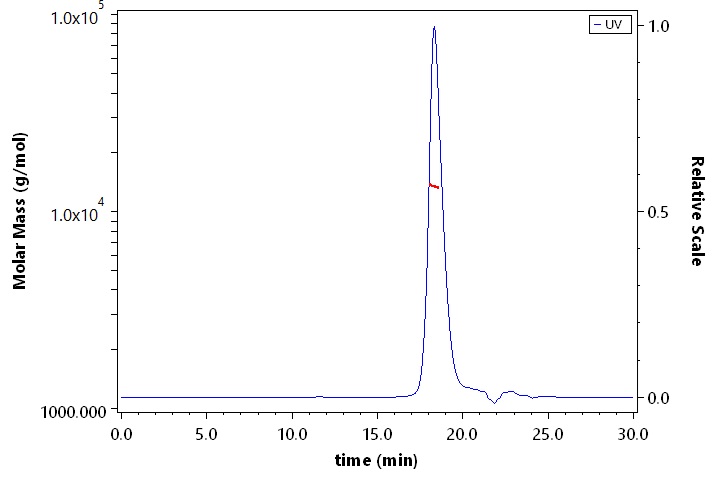
The purity of Human CCL1 Protein, Tag Free (Cat. No. CC1-H5213) is more than 90% and the molecular weight of this protein is around 9-16 kDa verified by SEC-MALS.
Report
Customer Reviews Writing Reviews
 VB2025-04-30
 LikesUsed this protein to check antibodies and test migration efficiency, mainly in preparation for larger assays and screening of most efficient proteins available. I tested this product through ELISA for a general screening and high-throughput analysis, but plan to integrate into a western blot in the future for further determination. Just be sure to keep in its lyophilized state (around -70°C) for strongest efficacy. Data results are satisfactory and high-confidence so far, and it seems to have generally simple protocol adaptability.
 Contact Us


 Drug Candidate Licensing