


 Nov 26, 2026
 Page Views:86


Physiological Significance, Action Mechanisms, and Disease Pathology
Reconstituting Cellular and Immune Signaling Networks
Systemic homeostasis relies on tightly orchestrated intercellular communication networks. Utilizing recombinant target antigens allows researchers to study defined molecular interactions in vitro; cellular assays are needed to assess downstream signaling:
• Immune Checkpoint Regulation: Soluble extracellular domains of immune checkpoint receptors and ligands—such as PD-1/PD-L1, CTLA-4/B7-1/B7-2, TIGIT/CD155, and LAG-3—enable measurements of receptor-ligand binding. Characterizing these interactions can complement cell-based studies of how inhibitory signaling downregulates T-cell receptor (TCR) activation, establishing the mechanistic foundation of modern immuno-oncology.[1]
• Cytokine Receptor Signaling Cascades: Recombinant interleukins (such as IL-2, IL-15, and IL-21) and growth factors bind selectively to cell-surface receptor complexes, activating downstream JAK-STAT, MAPK, and PI3K/AKT intracellular cascades to direct primary lymphocyte proliferation, survival, and lineage differentiation.
• Ligand-Induced Multimeric Receptor Activation: Many members of the Tumor Necrosis Factor Receptor Superfamily (TNFRSF) and Receptor Tyrosine Kinases (RTKs) signal through ligand-dependent receptor assembly. Recombinant multimeric ligands allow biophysicists to model spatial receptor clustering and support studies of downstream signaling when combined with cellular assays.
Metabolic Regulation, Enzymatic Homeostasis, and Disease Pathogenesis
Beyond intercellular signaling, recombinant enzymes and hormonal regulators serve as functional tools to model metabolic pathways and dissect disease etiologies:
• Enzymatic Kinetics and Metabolic Modeling: Expressing metabolic enzymes, protein kinases, and phosphatases enables precise determination of Michaelis-Menten kinetic constants (Km, Vmax), substrate turnover rates, and allosteric feedback inhibition mechanisms.
• Hormone Receptor Agonism: Engineered metabolic ligands, including Glucagon-Like Peptide-1 Receptor (GLP-1R) agonists, interact with Class B G-protein coupled receptors (GPCRs) to regulate glucose homeostasis.
• Pathological Correlations: Dysfunctional, mutated, or overexpressed proteins can contribute to human pathologies. Aberrant overexpression of RTKs (such as EGFR and HER2) drives uncontrolled oncogenic proliferation; dysregulation of pro-inflammatory cytokine pathways (including IL-6 in rheumatoid arthritis and IL-23/IL-17 in psoriasis) contributes to chronic inflammation; and receptor mutations disrupt metabolic equilibrium. Recombinant proteins provide defined reagents useful for studying these aberrant mechanisms and design targeted molecular interventions.
Bibliometric and Database-Based Evidence: Literature Trends Across Nature, Cell, and UniProt
The central importance of recombinant proteins across basic and translational life sciences is evidenced by quantitative publication trajectories and international database expansions over the past four decades:
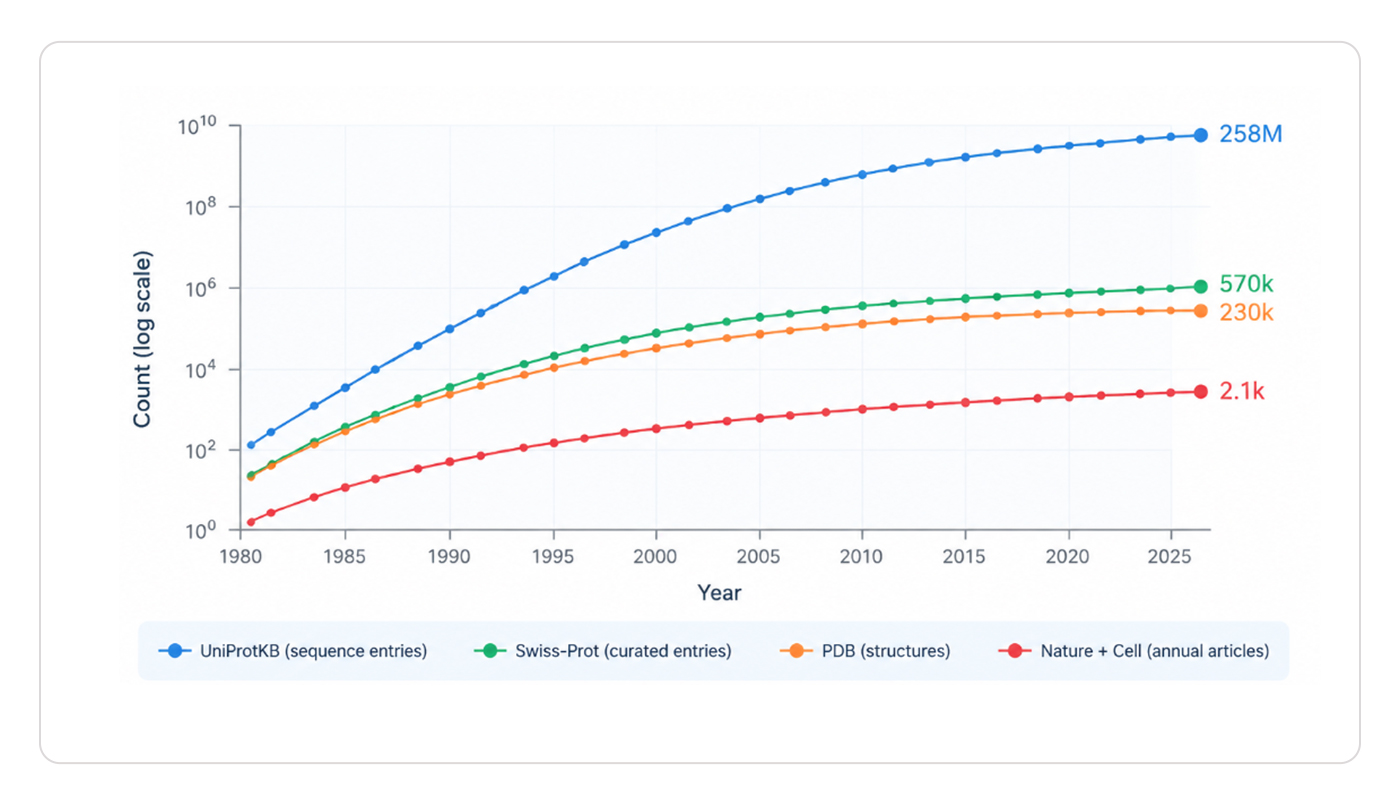
Figure 1: Long-Term Trends in Protein Sequence Databases, Structural Biology, and Scientific Publications (1980–2025)
Database Growth: UniProtKB and the Protein Data Bank (PDB)
The UniProt Knowledgebase (UniProtKB)—encompassing the manually reviewed Swiss-Prot section and the automatically annotated TrEMBL section—serves as the primary global repository for protein sequence and functional annotation. Tracking official releases illustrates a rapid expansion:[2]
• Sequence Record Expansion: UniProtKB contains a large and growing collection of sequence entries. These entries are primarily derived from coding-sequence translations, rather than counts of recombinant proteins.
• Literature Cross-Reference Density: Swiss-Prot entries cite relevant literature, but citation totals do not establish how many recombinant constructs have been experimentally characterized.
• Structural Integration in PDB: The Protein Data Bank (PDB) archives experimentally determined structures of proteins, nucleic acids, and complexes. Recombinant expression supports many, but not all, structural studies.[3]
Interpreting Publication Trends
Publication trends across Nature and Cell journal families require a defined search strategy and journal scope:
• Publication Search Scope: Search terms, journal coverage, and indexing dates should be stated before annual article counts or fold changes are compared.
• Research Applications: Published studies demonstrate broad use of recombinant protein tools in structural biology, chemical biology, and translational medicine.
Precision Biopharmaceuticals: From Chemotherapy to Targeted Modalities
The development of disease-specific recombinant proteins supported the development of targeted precision therapeutics in oncology and immunology.
The Paradigm Shift to Protein-Targeted Therapeutics
Historical cancer treatments relied heavily on cytotoxic chemotherapy and radiation. While effective at killing rapidly dividing cells, these agents can cause systemic toxicities.
The realization that diseases are driven by specific cell-surface and intracellular proteins transformed drug design:
• Target-Centric Discovery: Many disease targets are proteins. Characterizing target antigens contributed to the development of targeted monoclonal antibodies, exemplified by Trastuzumab (Herceptin) targeting HER2 in breast cancer and Pembrolizumab (Keytruda) blocking the PD-1/PD-L1 axis in diverse solid tumors.[4]
• Evolution of Complex Modalities: Recombinant target antigens enabled the engineering of sophisticated therapeutic formats:
a. Bispecific Antibodies & T-Cell Engagers (TCEs): Constructing dual-targeting molecules, such as Blinatumomab (CD19/CD3), to physically bridge cytotoxic T cells to malignant B cells.
b. Antibody-Drug Conjugates (ADCs): Harnessing antigen specificity to deliver potent cytotoxic payloads directly to tumor cells via internalizing receptors, exemplified by Trastuzumab deruxtecan (Enhertu).
c. Cell & Gene Therapies (CGT): Utilizing recombinant antigens to engineer chimeric antigen receptor (CAR) T-cells and deploying recombinant cytokines for ex vivo immune cell expansion.
• Computational AI Integration: Modern drug discovery increasingly employs generative AI architectures to model protein-protein interfaces, accelerating the de novo design of targeted therapeutic candidates against complex disease antigens.
Strategic Function Across the Biopharmaceutical R&D Lifecycle
Recombinant target antigens occupy a central functional role across each progressive stage of the drug development lifecycle:
• Target Identification & Validation: Recombinant extracellular domains (ECDs) and full-length target proteins support biochemical characterization and mapping of binding epitopes; disease linkage and tissue expression require separate evidence.
• High-Throughput Lead Discovery: Recombinant antigens serve as bait molecules in synthetic phage display, yeast display, and single B-cell screening campaigns to isolate high-affinity antibody clones.
• Biophysical Kinetics & Potency Profiling: Label-free optical biosensors (Surface Plasmon Resonance and Bio-Layer Interferometry) utilize immobilized recombinant antigens to measure association rate constants (ka), dissociation rate constants (kd), and equilibrium dissociation constants (KD), while cell-based assays quantify relative biological potency.
• CMC Quality Control & Bioanalytical Standardization: Pure, standardized recombinant proteins can serve as assay reagents or qualified reference materials in pharmacokinetic (PK) bridging ELISAs, anti-drug antibody (ADA) immunogenicity assays, and selected lot-release assays.
Conclusion: The Molecular Foundation of Modern Medicine
Recombinant protein technology represents an important experimental tool bridging fundamental molecular physiology with modern precision biopharmaceuticals. By decoupling complex cellular networks into defined, homogeneous molecular systems, recombinant proteins allow researchers to uncover fundamental disease mechanisms, contribute to structural research, and guide therapeutic discovery.
From validating novel disease targets to isolating monoclonal antibodies, optimizing multi-specific biologics, and standardizing clinical lot release, high-quality recombinant proteins remain valuable tools driving biological discovery and therapeutic innovation.