


 Nov 26, 2026
 Page Views:106


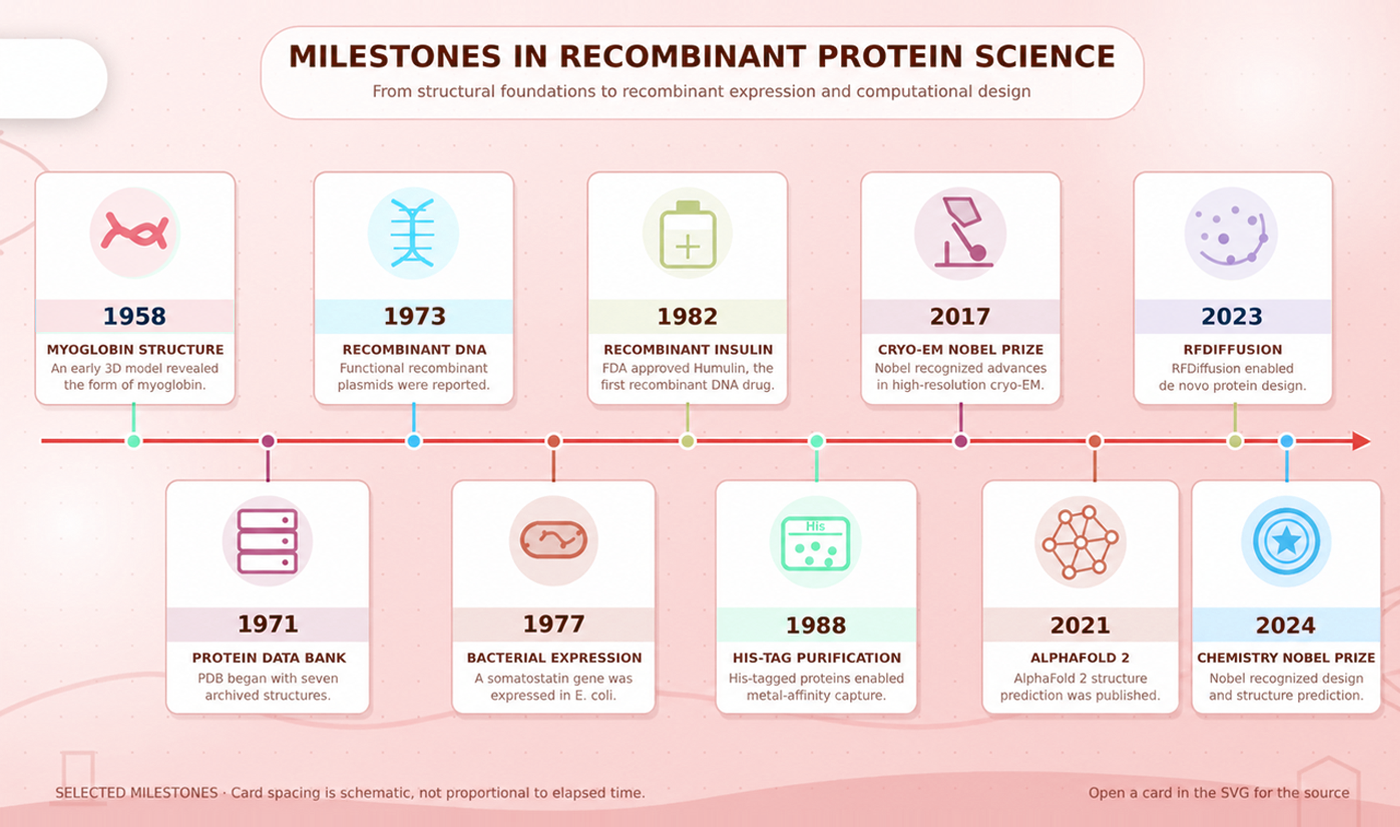
Figure 1:Selected milestones in recombinant protein science.
Structural Elucidation & Computational Evolution
The history of recombinant proteins is fundamentally intertwined with the progression of structural biology. Understanding the relationship between primary sequence, three-dimensional folding, and biological function has transformed protein science from qualitative biochemistry into generative computational design.
The Foundations: From Primary Sequence to Atomic Crystallography
Protein science gained a structural foundation by 1955 when Frederick Sanger completed the first full amino acid sequence of bovine insulin, demonstrating that proteins possess defined, linear covalent structures. In 1958, John Kendrew and colleagues reported an early three-dimensional X-ray model of myoglobin; Max Perutz worked on hemoglobin. Later refinements reached atomic resolution. To standardize and share atomic coordinates internationally, the Protein Data Bank (PDB) was established in 1971, building the public data infrastructure that anchors modern molecular research.
Solution Dynamics, Mass Spectrometry, and Structural Genomics
Because biological functions often depend on conformational dynamics in liquid environments, multidimensional solution Nuclear Magnetic Resonance (NMR) spectroscopy matured during the mid-to-late 1980s. Solution NMR enabled biophysicists to resolve dynamic loop movements and weak binding interfaces in physiological buffers without crystal lattice constraints. In the 1990s, soft ionization mass spectrometry (ESI and MALDI-TOF) enabled intact mass determination, peptide mapping, and post-translational modification (PTM) profiling without thermal fragmentation. By the early 2000s, international Structural Genomics consortia industrialized target cloning, expression, and automated crystallography, systematically expanding structural coverage across diverse protein families.
Cryo-EM Resolution and Deep-Learning Design
In the 2010s, direct electron detectors and advanced image reconstruction launched the Cryogenic Electron Microscopy (Cryo-EM) Resolution Revolution (recognized by the 2017 Nobel Prize in Chemistry). Cryo-EM can avoid crystallization and, for suitable samples, enable near-atomic structural determination of large macromolecular machines, transient assembly intermediates, and multi-pass membrane proteins in vitreous ice.
Between 2020 and 2021, deep learning architectures—led by AlphaFold2 and RoseTTAFold—substantially advanced protein structure prediction by predicting atomic coordinates directly from amino acid sequences [1].
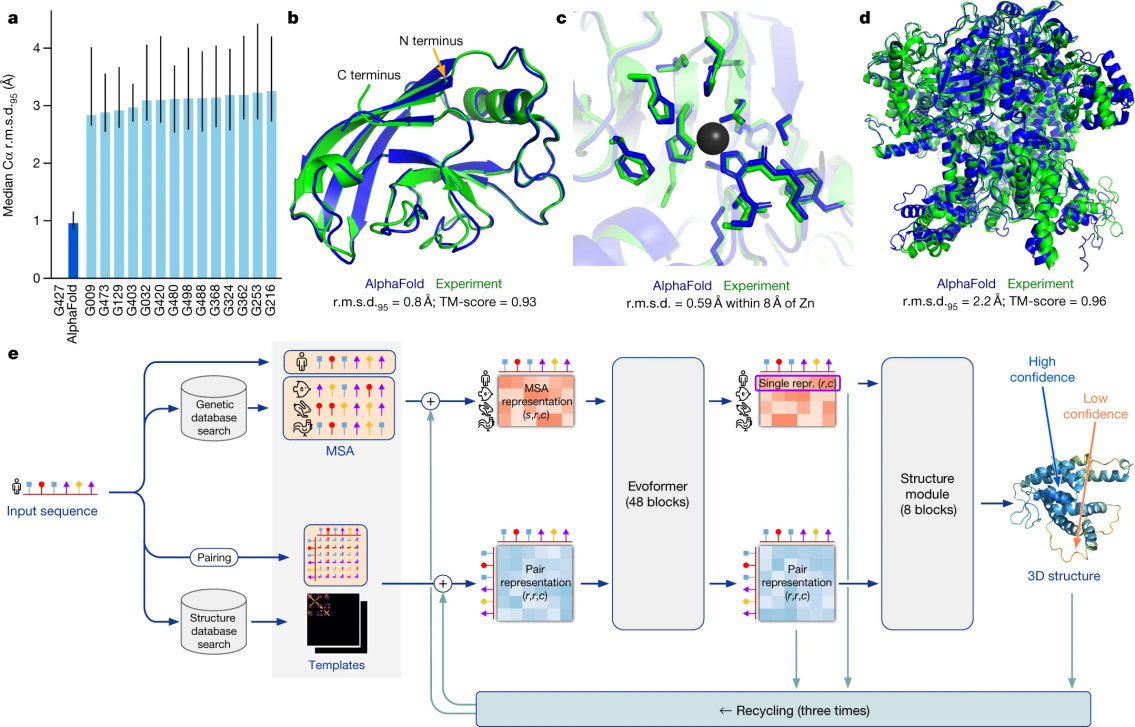
Figure 2:AlphaFold protein structure prediction performance, comparison with experimental structures, and model architecture. Reproduced from Jumper et al.[1] under CC BY 4.0.
Source: https://doi.org/10.1038/s41586-021-03819-2
This computational capacity rapidly transitioned from structural prediction to generative de novo design:
• Structure-Conditioned Sequence Design (2022): Frameworks like ProteinMPNN enabled the generation of amino acid sequences optimized to fold into predefined target backbones with high stability.
• Generative De Novo Modeling (2023): Diffusion architectures, such as RFdiffusion, allowed the de novo generation of customized protein backbones and functional interfaces from scratch [2].
• Biomolecular Complex Modeling (2024): AlphaFold 3 expanded predictive modeling to holistic assemblies, computing interactions between proteins, nucleic acids, small-molecule ligands, ions, and chemical modifications.
The 2024 Nobel Prize in Chemistry—honoring computational protein design and structural prediction—solidified an era where recombinant protein engineering operates as an integrated synthesis of experimental biophysics and de novo computational generation.
Biomanufacturing Milestones: Genetic Construction, Host Expression, and Downstream Purification
Parallel to structural insights, expression and purification bioprocesses advanced from crude bacterial transformations to automated mammalian biomanufacturing.
Genetic Vector Construction
The enzymatic foundation of molecular cloning was established around 1970 through the characterization of site-specific restriction endonucleases and DNA ligases (awarded the 1978 Nobel Prize). In 1973, Stanley Cohen, Herbert Boyer, and colleagues reported the construction and replication of functional recombinant plasmids in E. coli [3]. The publication of the Polymerase Chain Reaction (PCR) in 1985 reduced reliance on restriction-fragment isolation, accelerating target gene amplification, domain truncation, and site-directed mutagenesis.
Expression Host Diversification
Recombinant protein production progressively expanded across multiple expression hosts to accommodate folding complexity:
• Prokaryotic Systems (E. coli): Following early cell-free translation experiments in 1961 that cracked the genetic code, E. coli achieved the first heterologous expression of a mammalian peptide (Somatostatin) in 1977, proving synthetic feasibility.
• Yeast Expression Systems: Developed in the early 1980s (Saccharomyces cerevisiae, Pichia pastoris), yeast provided microbial growth kinetics alongside eukaryotic secretion and basic core N-glycosylation.
• Baculovirus-Insect Cell Systems: Established in 1983, insect cell platforms enabled high-yield expression of large multi-subunit assemblies and post-translationally modified membrane proteins.
• Mammalian Platforms (CHO & HEK293): Industrialized during the 1980s, mammalian suspension systems became the gold standard for therapeutic targets requiring human-like complex multi-antennary N/O-glycosylation, correct disulfide bridging, and native quaternary assembly.
• Engineered Cell-Free Systems (CFPS): Maturing in the 2000s, cell-free protein synthesis bypassed live-cell cytotoxicity, enabling rapid production of toxic proteins, membrane complexes, and proteins incorporating non-canonical amino acids.
• High-Throughput Automation: By the 2010s, automated transient transfection across HEK293 and CHO platforms enabled parallel screening of construct boundaries and expression conditions.
Chromatography and Multi-Dimensional Separation
Purification evolved from non-specific fractional precipitation and harsh inclusion body refolding toward high-affinity capture. A 1988 report on Ni-NTA immobilized metal affinity chromatography (IMAC) described a broadly useful capture method. From the late 1990s through the 2000s, pairing Size Exclusion Chromatography with inline Multi-Angle Laser Light Scattering (SEC-MALS) added solution-state molar mass and oligomeric assessment alongside purity assays.
Functional Toolkits and Tag Engineering
Following the 1982 regulatory approval of recombinant human insulin (Humulin) that validated microbial biomanufacturing over animal tissue extraction, and the emergence of the first targeted monoclonal antibody therapeutics in the late 1980s, recombinant proteins expanded from therapeutic agents into versatile molecular toolkits for discovery research.
Evolution of Affinity Fusion Tags and Cleavage Systems
During the 1980s and 1990s, fusion tag engineering standardized recombinant protein isolation. Affinity handles—including Polyhistidine (6x-His), Glutathione S-transferase (GST), Maltose-Binding Protein (MBP), and epitope markers (such as FLAG and Myc)—supported chromatographic capture, improved solubility for some constructs, or provided detection handles for immunoassays. To prevent non-native sequences from interfering with structural crystallography or functional bioassays, engineered cleavage recognition sites recognized by sequence-specific endoproteases (such as TEV protease, Enterokinase, and Thrombin) were incorporated, enabling precise post-purification tag excision to restore native protein boundaries.
From Random Chemical Labeling to Site-Specific Bio-Conjugation
As analytical biosensor assays expanded in the late 1990s, recombinant engineering transitioned from bulk affinity tags toward site-specific bio-conjugation. Legacy random chemical labeling (such as amine-reactive NHS-esters or thiol-reactive maleimides) generated heterogeneous mixtures and frequently occluded active binding sites.
This challenge drove key bio-conjugation milestones:
• 1998 (Expressed Protein Ligation): The development of Expressed Protein Ligation (EPL) utilizing engineered self-cleaving inteins enabled site-specific, semi-synthetic protein labeling and C-terminal modification.
• 1999 (Enzymatic Biotinylation Tags): The discovery of minimal 15-amino-acid peptide substrates specifically recognized by Escherichia coli biotin ligase (BirA) allowed targeted, single-site biotinylation on a designated lysine residue.
• Mid-2000s (Transpeptidase "Sortagging"): The establishment of Sortase A-mediated transpeptidation provided a modular route to attach fluorophores and biophysical handles to designated termini under mild physiological conditions.
These enzymatic innovations can support more controlled protein immobilization on SPR and BLI biosensors; epitope accessibility and binding kinetics still require validation.
Frontier Innovations: AI-Driven Protein Design and Closed-Loop Engineering
Modern recombinant protein engineering has advanced from directed evolution toward generative de novo computational design, leveraging machine learning to navigate vast biophysical fitness landscapes. Deep-learning architectures—integrating diffusion models and structure-conditioned sequence generators—rationally optimize conformational stability, binding interfaces, and catalytic efficiency within iterative design-build-test-learn (DBTL) cycles. Experimental validation remains necessary to establish whether a designed protein has improved stability or activity.
Conclusion
Recombinant protein science now forms an integrated continuum spanning sequence design, host expression, purification, and biophysical characterization. Driven by cryo-EM, mass spectrometry, and AI prediction, evaluation increasingly prioritizes authentic folding, oligomeric integrity, and batch-to-batch consistency. ACROBiosystems aligns with this evolution, delivering multi-dimensional validated recombinant protein portfolios across diverse targets, species, and functional tags to empower structural biology, antibody discovery, and biomedical innovation.