



 Aug 25, 2026
 Page Views:277


The $50 Billion Question
In 2014, the FDA approval of pembrolizumab ushered in a new era for cancer immunotherapy. Over the past decade, the PD-1/PD-L1 pathway has expanded across more than 15 indications and now underpins a global market approaching $50 billion, per the underlying CAS dataset analysis. Yet the data tell a sobering story: even among patients with tumors that are highly positive for PD-L1, more than 50% may not respond to PD-1/PD-L1 blockade. Immunologically "cold" tumors — pancreatic adenocarcinoma, glioblastoma, microsatellite-stable colorectal cancer — remain largely refractory to this approach.
This raises two critical questions: Why did PD-1 succeed? And where is the next PD-1?
A team at CAS used a comprehensive approach, including natural language processing (NLP), to analyze more than 350,000 immuno-oncology documents in the CAS Content Collection. This article draws on their review to examine the IO target landscape, with a focus on approved and clinical-stage candidates.
(Original review: https://www.cas.org/resources/cas-insights/immuno-oncology#lessons-learned-and-next-steps-for-immuno-oncology-targets)
Target Classification at a Glance
The CAS review organizes emerging IO targets into four development stages:
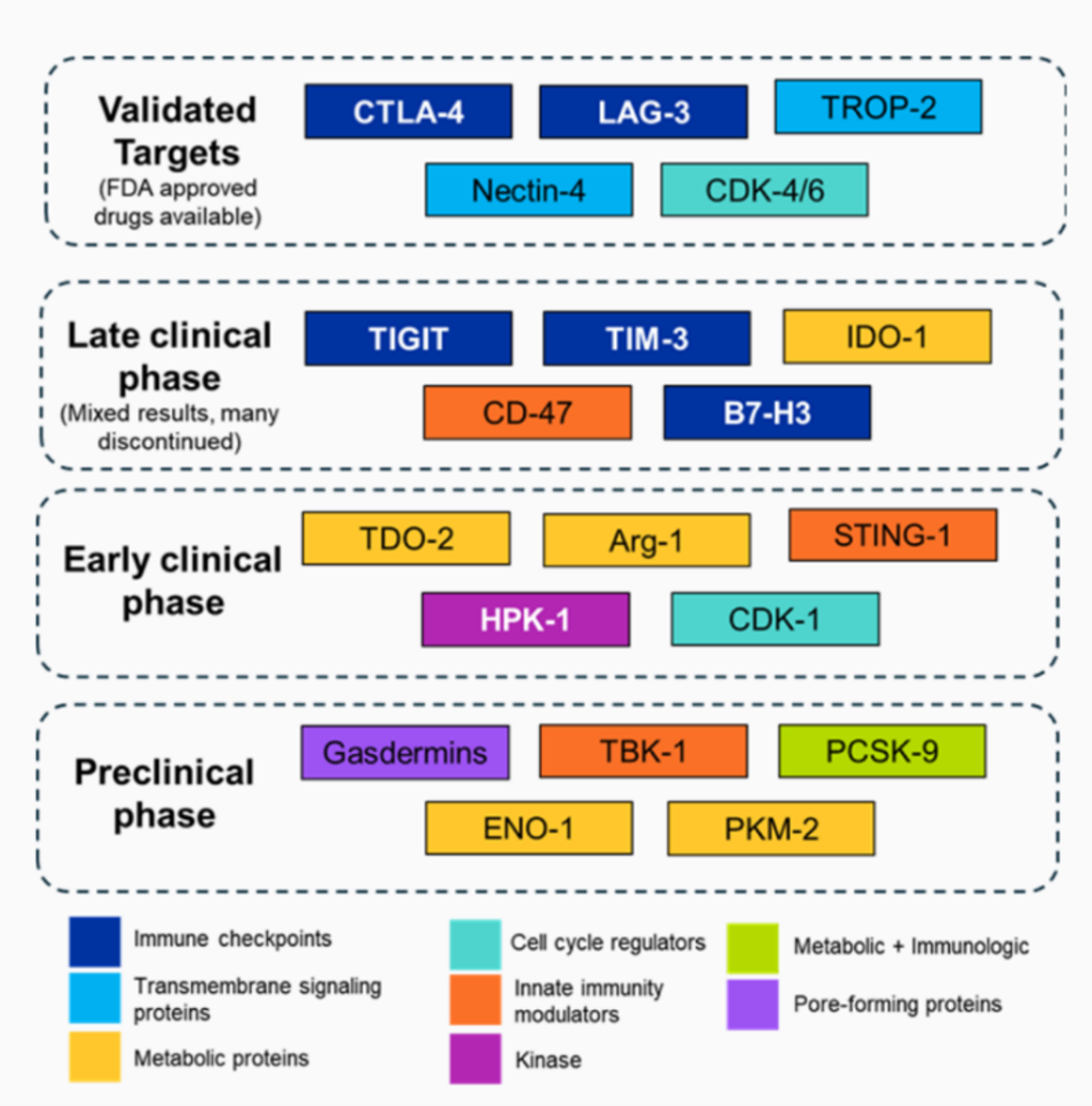
Figure 1: Overview of various emerging immune-oncological targets based on their clinical stage and mechanism. Source: CAS Content Collection.
This four-stage map captures both the breadth of IO research and the narrowing path from biological rationale to regulatory approval. The clearest starting point is the small group of non-PD-1/PD-L1 targets that have already crossed that threshold.
1. A Decade of Progress: Five Target Classes Beyond PD-1 Reach FDA Approval
To date, five distinct classes of IO targets — beyond PD-1/PD-L1 — have produced FDA-approved therapies:
CTLA-4 — represented by ipilimumab and tremelimumab — targets the priming phase of T-cell activation in lymphoid organs and stands as the pioneer of immune checkpoint blockade.
CDK4/6 — represented by palbociclib, ribociclib, and abemaciclib. Originally approved as cell cycle inhibitors, subsequent research revealed clinically relevant immunomodulatory effects, including sensitizing historically immunologically cold tumors. These agents exemplify how oncogene-targeted drugs can be repositioned as immune modulators.
TROP-2 — represented by sacituzumab govitecan, an antibody-drug conjugate (ADC).
Nectin-4 — represented by enfortumab vedotin, another approved ADC.
Taken together, TROP-2- and Nectin-4-targeted ADCs demonstrate that cytotoxic antibody conjugates can function as immuno-oncology agents by coupling targeted tumor-cell killing with immunogenic cell death, antigen release, and immune priming, particularly when paired with checkpoint blockade.
LAG-3 — represented by relatlimab in combination with nivolumab. As the third approved immune checkpoint target after CTLA-4 and PD-1/PD-L1, LAG-3 validated the premise that exhausted T-cell programs beyond PD-1 are therapeutically tractable, with a more favorable safety profile.
Five target classes, three broader paths to immune activation — checkpoint diversification, immunomodulatory small molecules, and immunogenic cytotoxic platforms. Together, they expand the therapeutic logic of immuno-oncology beyond PD-1 alone.
Regulatory approval, however, is only the starting line — more targets are now facing the most rigorous scrutiny in Phase III trials.
2. The Critical Validation Phase: Hits and Misses Among Four Phase III Targets
Phase III is where preclinical rationale and early clinical signals face more definitive testing. Across the four targets below, the mixed outcomes show why reaching a pivotal trial does not, by itself, resolve questions about target biology or therapeutic design. The program statuses described here reflect the period covered by the source article.
TIGIT — Represented by tiragolumab and domvanalimab, TIGIT advanced to Phase III on the strength of compelling preclinical data and encouraging Phase II results, only to face a series of setbacks: the lung cancer Phase III trial missed its primary endpoint, and the melanoma Phase III was terminated due to safety concerns. A different signal emerged with Gilead Sciences and Arcus Biosciences' domvanalimab — an Fc-silenced anti-TIGIT antibody — which produced positive results in a Phase II gastric cancer study. This suggests that antibody design and tumor context may influence outcomes, without establishing Fc silencing as a general solution for TIGIT.
TIM-3 — Novartis' sabatolimab was discontinued after failing to meet Phase II endpoints; GSK's cobolimab failed to improve overall survival in Phase III. However, cobolimab continues to be evaluated in pediatric oncology and advanced hepatocellular carcinoma, and several bispecific antibodies are showing early promise.
CD47 — Despite a compelling preclinical rationale (blocking the "don't eat me" signal), clinical translation has proven challenging. Multiple candidate molecules have encountered mixed efficacy and safety outcomes in the clinic.
B7-H3 (CD276) — Its receptor remains unknown, and whether it functions as a co-stimulatory or co-inhibitory molecule remains debated. GSK's risvutatug rezetecan (an anti-B7-H3 ADC) has advanced to Phase III. Multiple parallel approaches — CAR-T, bispecific antibodies, and other modalities — are being pursued simultaneously.
The setbacks observed with TIGIT, TIM-3, and CD47 cannot be attributed to first-generation molecular design alone. Target biology, therapeutic modality, safety, tumor context, and patient selection may all contribute. These lessons also provide the context for assessing the next group of early-stage targets.
3. The Next Wave: Five Early-Stage Clinical Targets
These early-stage candidates highlight the expanding scope of the immuno-oncology field and underscore opportunities to complement existing checkpoints through novel mechanisms.
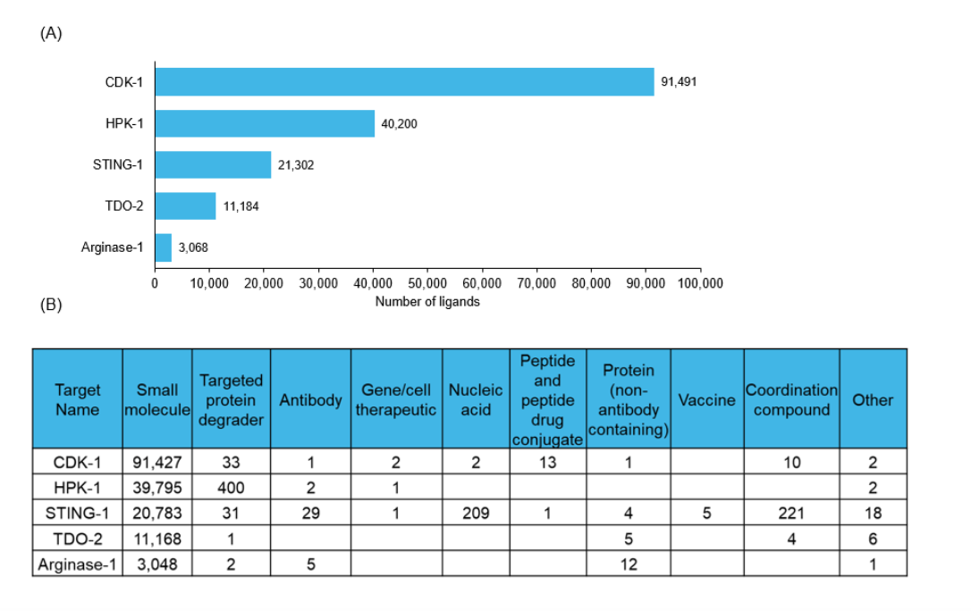
Figure 2: (A) Number of ligands and (B) ligand types reported for five early-stage targets. Original figure 3 in CAS Insights; source data: CAS Content Collection.
4. Early-Stage Target Profiles
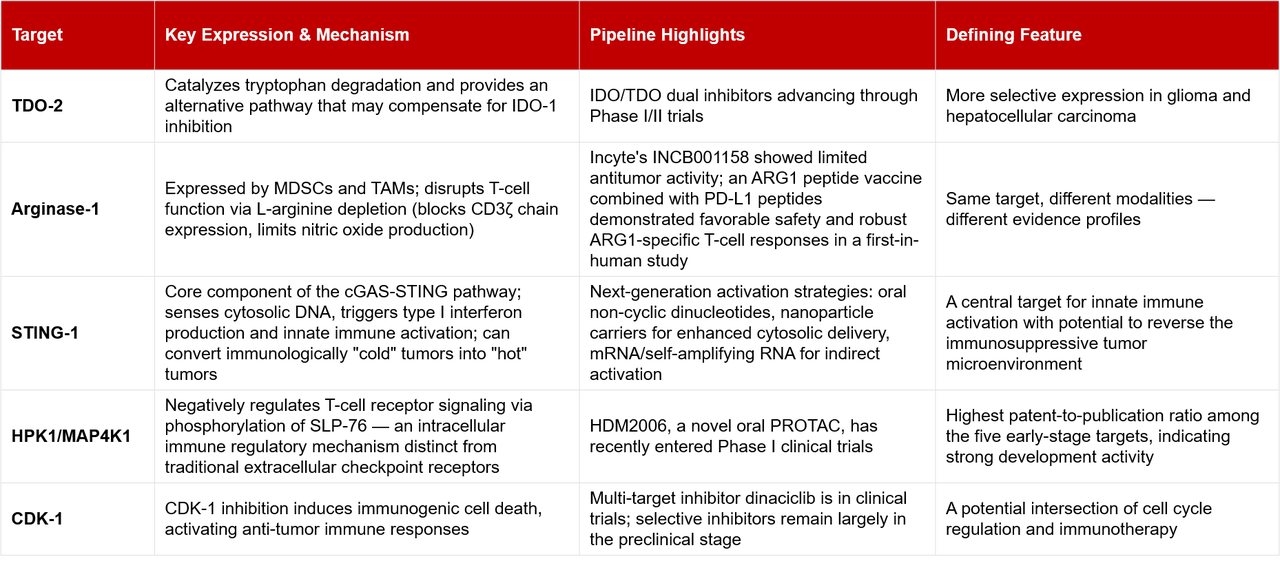
These clinical cases illustrate that a target's success depends not only on its biological foundation but also on drug modality, patient selection, and combination strategy.
Lessons Learned: What Made PD-1 Different?
Why did PD-1 succeed? As the CAS review states: "The success of PD-1/PD-L1 blockade highlights the importance of targeting immune evasion mechanisms that are evolutionarily dominant and spatially confined to the tumor microenvironment." This does not mean that every tumor depends on PD-1/PD-L1. Instead, it highlights the value of targeting immune-evasion mechanisms with strong selective relevance and tumor-microenvironment specificity — characteristics that many emerging checkpoints may not share to the same degree. That biological distinction is only part of the answer; the clinical examples above also show that modality shapes how a target is tested.
Same target, different modalities, divergent evidence. B7-H3 has produced different development paths across antibodies, ADCs, CAR-T cells, and bispecific antibodies. Arginase-1 showed limited activity with a small-molecule inhibitor, whereas a peptide vaccine produced favorable safety and ARG1-specific T-cell responses without yet establishing clinical efficacy. TIGIT's first-generation antibodies stumbled, while an Fc-silenced design showed promise in a selected tumor type. Choosing the right target is only the starting point — modality influences, but does not determine, success.
The ligand landscape adds another layer to this picture. The CAS Content Collection includes ~91,000 ligands for CDK-1, ~40,000 for HPK-1, and ~21,000 for STING-1. These counts indicate the breadth of research activity, not clinical maturity or probability of success.
The same shift from empirical choice to mechanism-based matching also applies to combination strategy. The next decade will require moving beyond simple checkpoint combinations toward a mechanism-driven, biomarker-guided, modality-matched approach.
Against the original question of "where is the next PD-1", the landscape does not point to one universal successor. Instead, it points to a more selective model of progress in which target biology, modality, biomarkers, and combination strategy must align.
IO R&D Toolbox
Translating these development questions into experiments requires tools for target characterization, screening, functional evaluation, and bioanalysis. ACROBiosystems has developed a portfolio of 500+ immune checkpoint-related products aligned with industry R&D priorities. The portfolio spans high-activity target proteins, inhibitor screening kits, functional cell lines, and drug concentration assay kits — supporting emerging target validation, antibody screening and characterization, functional evaluation, manufacturing quality control, and bioanalytical method development.
Featured Targets
More immune checkpoint products

![[Latest Research] Mechanism of Transferrin in Promoting Fatty Acid Oxidation and Liver Tumor Growth](https://console.acrobiosystems.com/public/uploads/image/1742798080168012766.jpg)