


 Nov 26, 2026
 Page Views:46


Table 1: Functional Potency Assays & Biophysical Stability Matrix
Validation Dimension | Analytical Methodology | Key Biological & Physicochemical Readout | Quality & Regulatory Significance |
|---|---|---|---|
Label-Free Binding Kinetics | Surface Plasmon Resonance (SPR) / BLI | Association rate (ka), dissociation rate (kd), affinity (KD) | Confirms functional epitope accessibility and kinetic affinity parameters |
Cellular Potency Assays | Proliferation, Reporter Gene, Cytokine Release | Half-maximal effective concentration (EC50 / ED50) | Validates physiological signal transduction and intracellular potency |
Thermal & Colloidal Stability | nanoDSF, Static / Dynamic Light Scattering | Melting temp (Tm), aggregation onset (Tagg), radius (Rh) | Identifies optimal buffer matrices to prevent self-association |
Accelerated Shelf-Life Modeling | Arrhenius kinetic thermal stress testing | Degradation rate constants across elevated temperatures | Supports stability assessment alongside real-time data |
Biological Activity & Potency Validation: Kinetics, Cell Signatures, and Catalysis
Establishing biological potency requires evaluating recombinant proteins across physical, cellular, and enzymatic functional levels.
Label-Free Molecular Interaction Kinetics (SPR & BLI)
Optical biosensors—specifically Surface Plasmon Resonance (SPR) and Bio-Layer Interferometry (BLI)—quantify real-time, label-free binding interactions between recombinant target antigens and candidate therapeutics. By measuring association rate constants (ka) and dissociation rate constants (kd), biophysicists calculate equilibrium dissociation constants (KD).
For reliable kinetic analysis, recombinant targets benefit from appropriate sample quality and controlled biosensor presentation (such as terminal enzymatic biotinylation). This orientation can reduce epitope occlusion and avidity artifacts associated with randomly coupled or aggregated ligands.
Cell-Based Functional Bioassays & Relative Potency Calibration
While biosensors measure physical affinity, cell-based bioassays confirm downstream biological activation. Depending on the target class, functional potency is evaluated through:
• Primary Cell Proliferation Assays: Measuring cytokine-dependent lymphocyte expansion (e.g., primary T/NK cell proliferation driven by IL-2, IL-15, or IL-21).
• Reporter Gene Bioassays: Utilizing stable engineered cell lines (such as NF-kB or STAT3 luciferase reporter systems) to measure receptor-mediated transcriptional activation.
• Immune Checkpoint Blockade Assays: Quantifying the reversal of T-cell inhibition induced by antagonist antibodies blocking checkpoint pairs (such as PD-1/PD-L1 or TIGIT/CD155).
To mitigate day-to-day instrument drift, cell passage variability, and operator variance, analytical teams incorporate qualified internal reference standards where appropriate in every assay plate. Calculating relative potency ratios (sample EC50 relative to standard EC50) supports comparison with product-specific acceptance criteria.
Enzymatic Activity & Catalytic Kinetics
For recombinant enzymes, protein kinases, and tool nucleases, functional validation requires determining catalytic parameters under steady-state conditions. Measuring substrate turnover velocities establishes the Michaelis constant (Km), maximum reaction rate (Vmax), and specific catalytic activity (Units/mg), supporting assessment of catalytic function.
Stability Profiling: Formulation Design, Aliquoting SOPs, and Cold-Chain Logistics
Preserving the structural integrity of recombinant proteins throughout distribution and long-term storage requires formulation matrices engineered around thermodynamic stabilization principles.
Conformational and Colloidal Stability Screening
Thermal stress profiling evaluates both conformational stability (resistance to thermal unfolding) and colloidal stability (resistance to self-association). Multi-parameter screening platforms (such as nanoDSF paired with static and dynamic light scattering) measure three critical biophysical parameters:[2]
• Melting Temperature (Tm): Measures the midpoint of thermal unfolding under the defined assay conditions.[2]
• Aggregation Onset Temperature (Tagg): Estimates the temperature at which aggregation becomes detectable under the assay conditions.[2]
• Hydrodynamic Radius (Rh) & Polydispersity Index (PDI): Dynamic Light Scattering (DLS) quantifies particle size distributions, while PDI alone cannot confirm an aggregate-free formulation.[1]
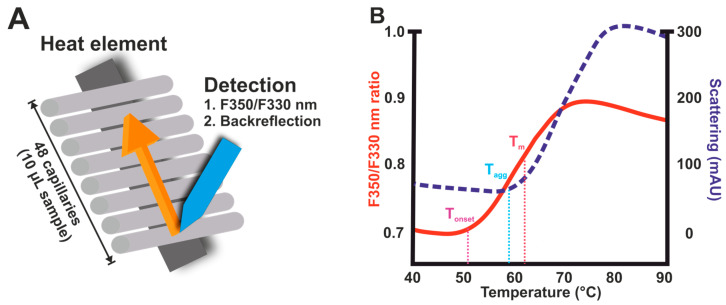
Figure 1. NanoDSF measurement principles and illustrative fluorescence-ratio and light-scattering profiles for protein unfolding and aggregation. Reproduced from Gooran et al. under CC BY 4.0
Source: https://doi.org/10.3390/ijms25031764
Formulation Thermodynamics: Lyophilized vs. Liquid Frozen Formats
Formulation matrices prevent physical and chemical degradation through complementary excipient mechanisms:
• Disaccharide Cryoprotectants (Trehalose or Sucrose): Can stabilize proteins during lyophilization via two mechanisms: Vitrification, which forms a high-viscosity amorphous glassy matrix that immobilizes protein molecules to prevent diffusion-driven collision; and the Water Replacement Hypothesis[3], where sugar hydroxyl groups form hydrogen bonds with surface residues to preserve native tertiary structure upon dehydration.
• Non-Ionic Surfactants (Polysorbate-20 or Polysorbate-80): Preferentially adsorb to hydrophobic air-water and container-water interfaces, potentially reducing agitation-induced shear denaturation and subvisible particle formation.[4]
Sterile Aliquoting, Cleanroom Fill-Finish, and Reconstitution SOPs
For applicable GMP-grade products, controlled aseptic filling can reduce bioburden risks. Purified proteins are packaged in low-protein-binding polypropylene tubes to prevent wall adsorption at low concentrations.
To avoid ice-crystal-induced shear stress during repeated freeze-thaw cycles, users should aliquot stock solutions upon initial reconstitution. Lyophilized cakes must be rehydrated undisturbed with the diluent and for the time specified in the product instructions, followed by gentle inversion, strictly avoiding vigorous vortexing that creates damaging air-liquid foam interfaces.
Long-Term Storage & Temperature-Monitored Cold-Chain Logistics
Real-time stability may be supplemented by accelerated studies; extrapolation, especially to frozen storage, requires validation and does not replace real-time data.
During global distribution, products are shipped under temperature conditions appropriate to their formulation, with monitoring and logistics processes to support cold-chain continuity.
Conclusion
Recombinant protein validation represents the essential link connecting upstream molecular design, biophysical stability, and translational efficacy. Reliable scientific outcomes depend on target proteins that combine verified binding kinetics, cellular potency, optimized formulation matrices, and traceable cold-chain integrity.
ACROBiosystems describes its quality and production process controls on its public quality pages:
• International Quality Accreditations: ACROBiosystems reports ISO 9001 and ISO 13485 certification and offers CNAS-accredited SPR testing services.
• GMP Biomanufacturing Infrastructure: Operating more than 3,000 m² of GMP cleanroom space, including B+A areas for aseptic formulation, automated sterile filling lines, environmental monitoring, and Aseptic Process Simulation (APS) media fills.
• Data Integrity & Regulatory Support: Computerized systems comply with US FDA 21 CFR Part 11 for complete electronic audit trails. Product-specific release tests and regulatory support documents are available; acceptance criteria and documentation should be checked for each product.