COA
COA


- Product Details
- Performance Data
- Reviews & Citations
- Resources
1/1
Assay Type | Competition-TR-FRET |
Reactivity | Human |
Regulatory Status | RUO |
Assay Time | 1 h |
Sample volume | 10 μL |
The Human HGF / HGF R Inhibitor Screening Kit (TR-FRET) is based on a homogeneous (no wash) competition TR-FRET technology (Time-Resolved Fluorescence Resonance Energy Transfer) to screen for inhibitors of human HGF binding to HGF R within one hour. It can also be used as a universal detection tool to identify the ability of human HGF to bind to human HGF R.
1. Store the unopened kit at 2-8°C upon receipt.
2. Locate the expiration date on the outer packaging and do not use reagents beyond their expiration date.
3. The opened kit should be stored according to the storage conditions listed in the Components Table. The shelf life of the opened kit is 30 days from the date of opening.
ID | Components | Size |
FRTP041-C01 | Human HGF R Protein Europium-chelate | 100 tests/500 tests |
FRTP041-C02 | FA Labeled Human HGF Protein | 100 tests/500 tests |
FRTP041-C03 | Anti-HGF R Neutralizing Antibody | 30 μg/100 tests 150 μg/500 tests |
DB-04 | TR-FRET Sample Dilution Buffer, pH7.4 | 50 mL/100 tests & 500 tests |
DB-05 | TR-FRET Detection Buffer, pH7.4 | 50 mL/100 tests & 500 tests |
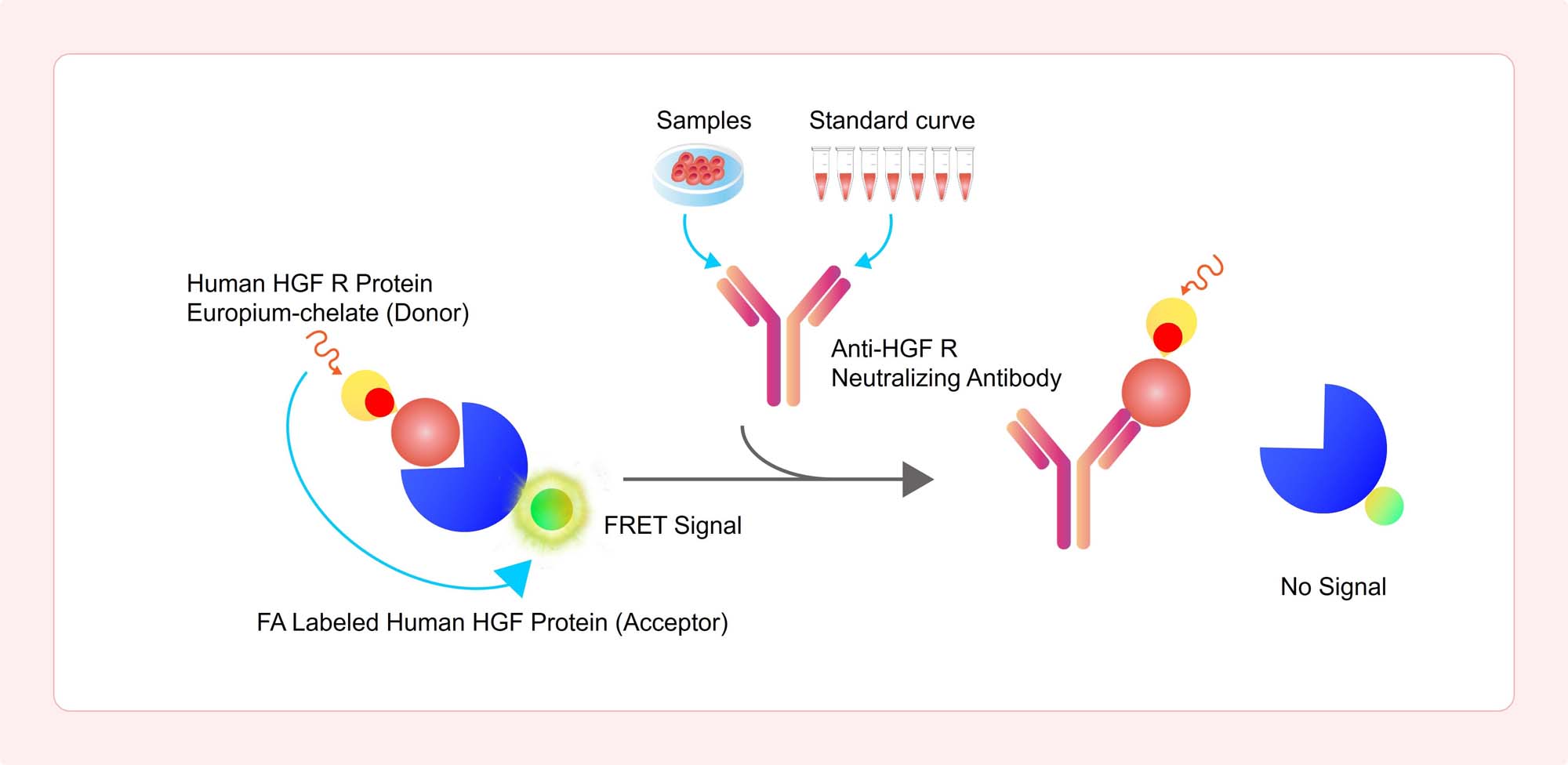
This Human HGF / HGF R Inhibitor Screening Kit (TR-FRET) is based on TR-FRET technology (Time-Resolved Fluorescence Resonance Energy Transfer). This assay uses the mixture of biotinylated human HGF R and Europium-chelate labeled streptavidin as the Donor and FA Labeled Human HGF Protein as the Acceptor.
— When the sample does not contain the inhibitors that block the binding of human HGF to human HGF R, the Donor and Acceptor are in close proximity because of the binding of human HGF and human HGF R. Upon Donor excitation with light of a specific wavelength (337 nm), in addition to Donor emission (620 nm), non-radiative transfer of energy occurs between Donor and Acceptor, resulting in Acceptor emission (665 nm).
— When the sample contains the inhibitors that block the binding of human HGF to human HGF R, the components inhibit the binding between the Donor and Acceptor and thereby prevent FRET from occurring.