

Human DLL3 coupled magnetic beads (2 µm)

Customer Reviews
Cat. No. / Size
Price
Availability
Qty
MBC-K203-2mg
$1070.00
MBC-K203-10mg (5mg X 2)
$3350.00

Product Details

  • Items
    Size 2mg
    Size 10mg (5mg × 2)
    Particle size
    2 μm
    2 μm
    Physical appearance
    Powder mixture
    Powder mixture
    Source
    AA Ala 27 - Ala 479 (Accession # Q9NYJ7-1)
    AA Ala 27 - Ala 479 (Accession # Q9NYJ7-1)
    Amount of Coupled Protein
    >321.54 pmol(20μg) Human DLL3 Protein /mg Beads
    >321.54 pmol(20μg) Human DLL3 Protein /mg Beads
    Formulation
    PBS, pH7.4, with 10% Trehalose
    PBS, pH7.4, with 10% Trehalose
    Reconstitution
    2 mL sterile deionized water (1 mg beads/mL)
    5 mL sterile deionized water (1 mg beads/mL)
  • Product Description

    The Human DLL3-coupled Magnetic Beads is produced by coupling biotinylated human DLL3 protein to streptavidin-conjugated magnetic beads. The pre-coupled beads are ready to use for capturing anti-DLL3 antibody from your sample with high specificity. The uniform size and large surface-to-volume ratio of the beads ensure highly efficient immunocapture in a simple, fast and convenient workflow with high reproducibility of data.

  • Application

    This product is intended for immunocapture, biopanning. This is a non-sterile product.

    * The Isotype control (Cat. No. SMB-B01) is sold separately.

  • Reconstitution

    See Certificate of Analysis (CoA) for detailed instruction.

  • Storage

    Upon receipt, please store the lyophilized beads at -20°C for long term storage. The shelf life is 2 year at -20°C in lyophilized form.

    Please avoid more than 3 freeze-thaw cycles once reconstitution, immediate use after reconstitution is highly recommended.

  • ACRO Quality Management System

    1. QMS(ISO, GMP)
    2. Quality Advantages
    3. Quality Control Process

Customers Also Viewed

Performance Data

  • Typical Data

     DLL3 TYPICAL DATA

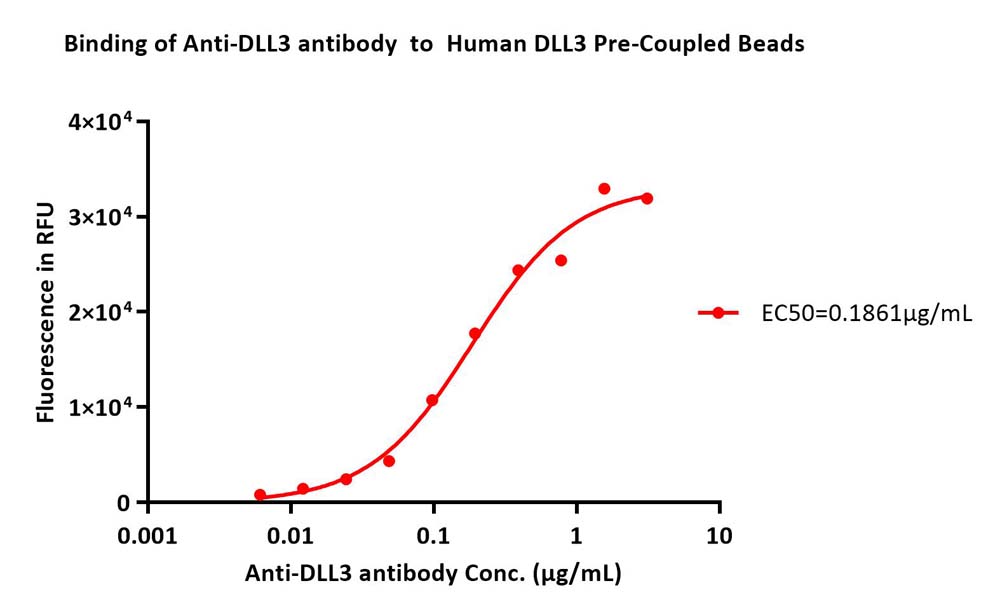
    Immobilized 20 μg Human DLL3 to 1mg Beads can bind the Anti-DLL3 with an EC50 of 0.1861 μg/mL.

    Protocol

Customer Reviews
Writing Reviews

FAQ

  • product

    Can lyophilized proteins remain stable during room-temperature shipping or temporary room-temperature exposure?

    In general, lyophilized proteins remain stable during room-temperature shipping or temporary exposure to room-temperature conditions.


    Many ACROBiosystems recombinant proteins are supplied in lyophilized (freeze-dried) form. The lyophilization process effectively removes moisture from the product, helping reduce degradation-related reactions and improve protein stability during transportation and storage.


    To evaluate the stability of lyophilized proteins under normal temperature conditions, ACROBiosystems conducted a stability study on 11 representative lyophilized protein products at 37°C. The study demonstrated that these proteins maintained good quality stability after storage at 37°C for approximately 20 days. Based on these validation results, temporary room-temperature exposure during shipping or handling is generally not expected to have a significant impact on product quality or downstream application performance.


    To ensure optimal long-term stability, products should be stored according to the storage conditions specified in the product Certificate of Analysis (COA) upon receipt.


    Supporting Document


Recent Advances

 
Drug Development Progress
  • English Name:

    Delta-like protein 3

  • Category:

  • Approved Drugs:

    1 Details

  • Drugs in Clinical Trials:

    28 Details

  • Highest Development Stage:

    Approved

Drug Candidate Licensing
More
  • Basic Product Information
  • Product Details
  • Customers Also Viewed
  • Performance Data
  • Customer Reviews
  • FAQ