


Monoclonal Anti-Her2 Antibody, Human IgG1

Cat. No. / Size
Price
Availability
Qty
HE2-M598-100ug
$230.00
In Stock - Delivery in 1-2 business days
HE2-M598-1mg
$1,380.00
In Stock - Delivery in 1-2 business days
HE2-M598
Sub-Total :
$ 0
0
Add to Cart
Customize Product Request Quote
Contact Us
Contact Us
Sub-Total:
$ 0
0
Add to Cart
  • Product Details
  • Performance Data
  • Reviews & Citations
  • Important Statement
  • Resources
Source

Monoclonal Anti-Her2 Antibody, Human IgG1 is recombinantly expressed in HEK293. It consists of mouse variable regions genetically fused to human constant domains.

Antibody Type

Recombinant Monoclonal

Clone

AM598

Isotype

Human IgG1, Kappa

Host Species

Mouse

Reactivity

Human

Specificity

This product is a specific antibody against Her2.

Application
Application
Recommended Use
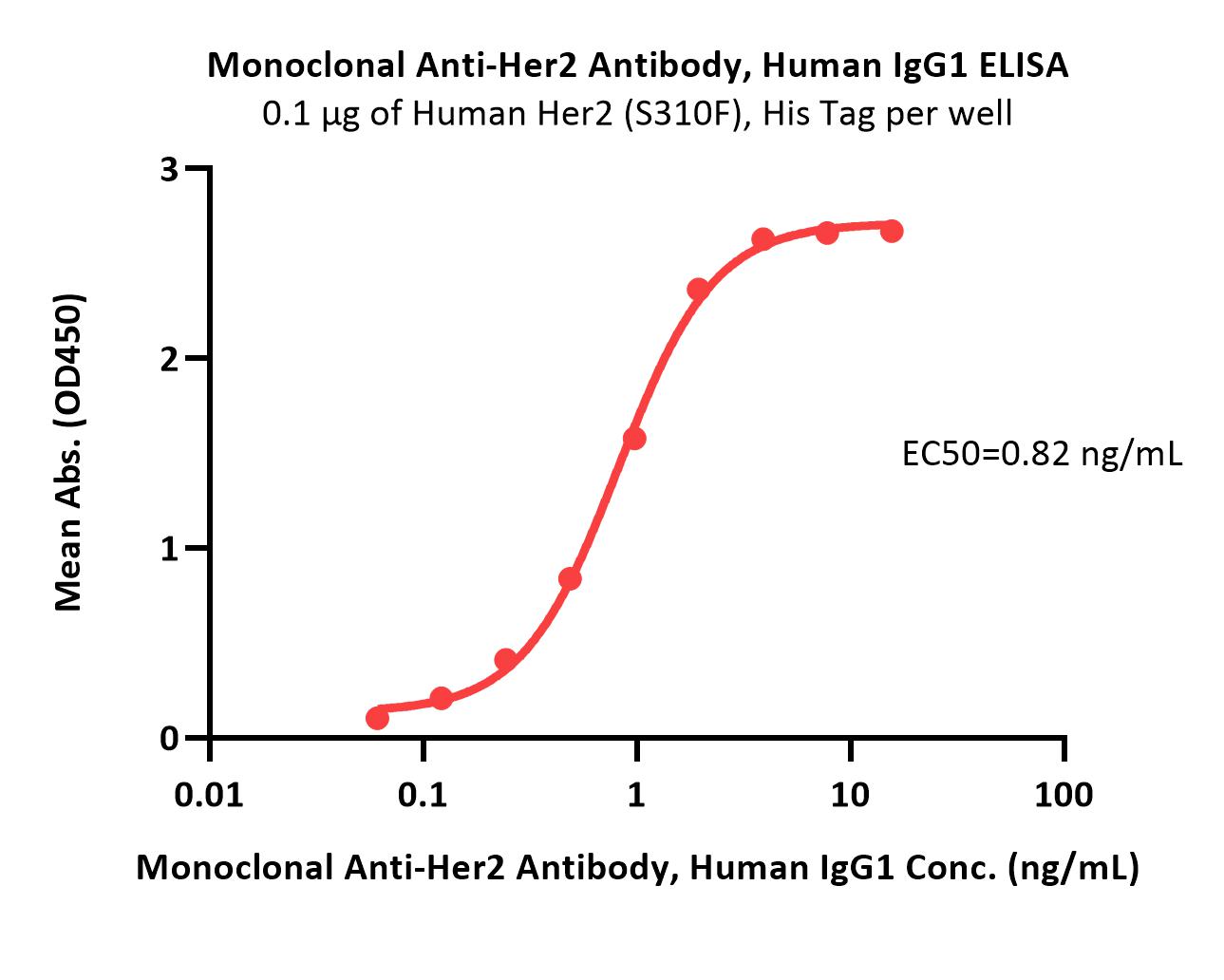
ELISA
0.2-2 μg/mL

* Recommended dilutions are for reference only. Optimal working concentrations may vary depending on your consumables, reagents, and assay conditions. We recommend optimizing for your specific system. No warranty is made regarding performance at any specific dilution.

Purification

Protein A purified.

Concentration

Please refer to the Certificate of Analysis (CoA).

Form

Liquid

Formulation

Supplied a 0.22 μm-filtered solution in pH 6.0, 20 mM L-Histidine, with trehalose as protectant.

Please contact us for customized product forms or formulations.

Storage

Please avoid repeated freeze-thaw cycles.

This product is stable after storage at:
  • The product MUST be stored at -70°C or lower upon receipt;
  • -70°C for 12 months under sterile conditions.
Notices

Product Specific Notices: For research use only.

Background

Human Epidermal growth factor Receptor 2 (HER2) is also called ERBB2, HER-2,HER-2 /neu, NEU, NGL,TKR1 and c-erb B2,and is a protein giving higher aggressiveness in breast cancers. It is a member of the ErbB protein family, more commonly known as the epidermal growth factor receptor family. HER2 is a cell membrane surface-bound receptor tyrosine kinase and is normally involved in the signal transduction pathways leading to cell growth and differentiation. HER2 is thought to be an orphan receptor, with none of the EGF family of ligands able to activate it. Approximately 30% of breast cancers have an amplification of the HER2 gene or overexpression of its protein product. Overexpression of this receptor in breast cancer is associated with increased disease recurrence and worse prognosis. HER2 appears to play roles in development, cancer, communication at the neuromuscular junction and regulation of cell growth and differentiation .