

Product Details
Application
The Monoclonal Anti-Flag Tag Antibody FA-Labeled is a universal tool for TR-FRET assays that can bind Flag-tagged proteins. This product uses specific anti-Flag Tag antibody labeled with fluorescent dyes and it can be used in combination with other Donors covalently conjugated with Eu³⁺ chelate. When the Donor and Acceptor come into close proximity (within a distance of less than 10 nm), a FRET reaction occurs: the 620 nm signal emitted by the Donor upon excitation by a specific light source is received by the Acceptor, which then emits a 665 nm signal.Product Specifications
SourceThis Monoclonal Anti-Flag Tag Antibody, Rabbit IgG is a rabbit monoclonal antibody recombinantly expressed from HEK293.SpecificityThis antibody specifically reacts with Flag tag proteins, and can recognizes C-terminal and N-terminal Flag tagged fusion proteins.FormulationLyophilized from 0.22 μm filtered solution in PBS, pH7.4 with trehalose as protectant.Physical AppearancePowderStorage (unopened)-20°C to -70°CStorage (opened)-70°CUnit Size1000 tests & 5000 tests & 20000 testsTechnologyTR-FRETIntended UseFor binding the flag-tagged protein as Acceptor in TR-FRET AssayReconstitution
Please see Certificate of Analysis for specific instructions.
For best performance, we strongly recommend you to follow the reconstitution protocol provided in the CoA.
ACRO Quality Management System
Customers Also Viewed
Performance Data
Bioactivity-TR-FRET
Please refer to DS document for the assay protocol.

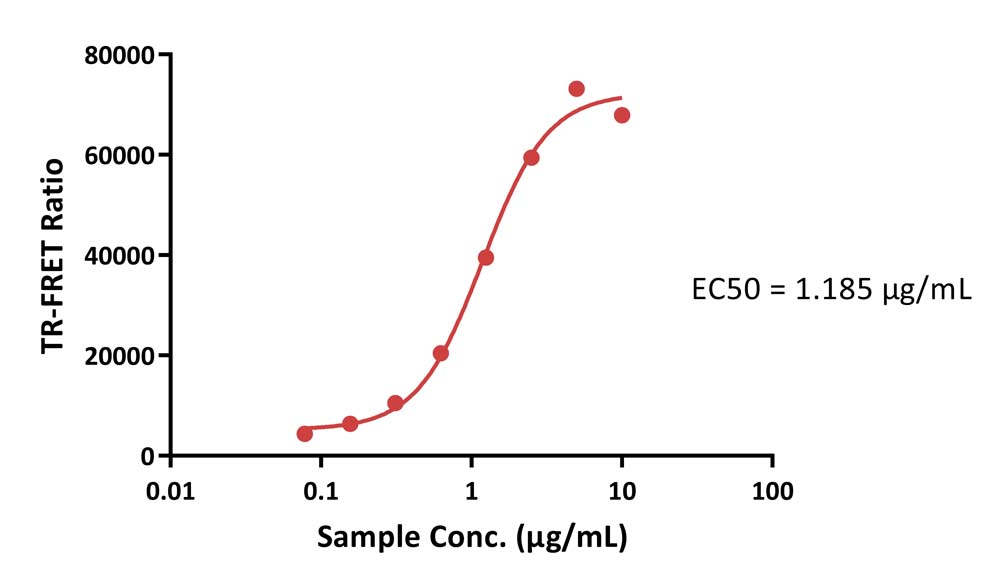
In this TR-FRET assay, Streptavidin Protein Europium chelate (Cat. No. FRT-TD09) is used as the Donor and Monoclonal Anti-Flag Tag Antibody FA-Labeled (Cat. No. FRT-TA06) is used as the Acceptor. Biotinylated Human CD40 Protein, Fc,Avitag (Cat. No. TN5-H82F9), at 12.5 ng/well, can bind to the Human CD40 Ligand, His,Flag Tag, premium grade (Cat. No. CDL-H52Db) with a linear detection range of 10-0.078 μg/mL (QC tested).

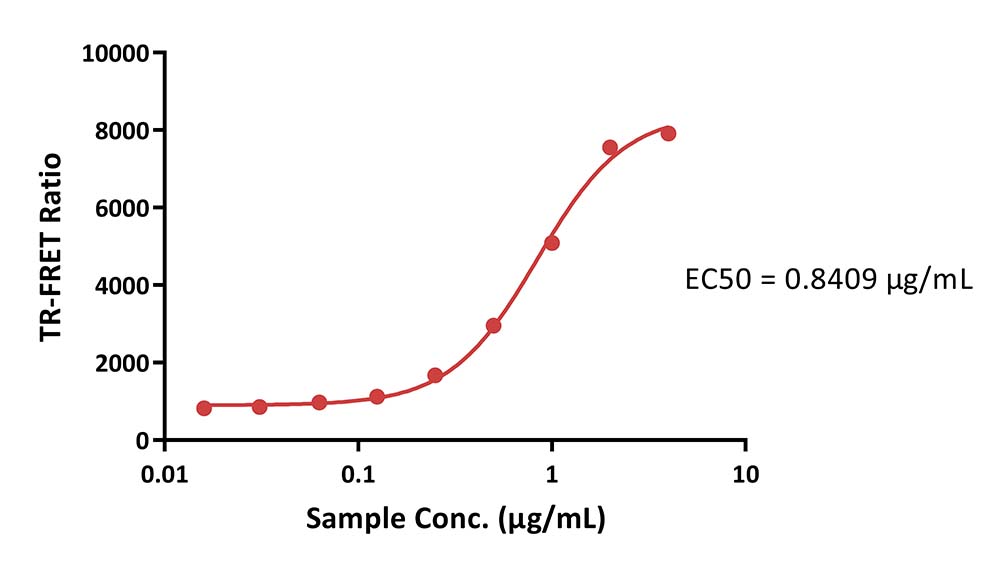
In this TR-FRET assay, Streptavidin Protein Europium chelate (for TR-FRET) (Cat. No. FRT-TD09) is used as the Donor and Monoclonal Anti-Flag Tag Antibody FA-Labeled (for TR-FRET) (Cat. No. FRT-TA06) is used as the Acceptor. Human CD3E&CD3D Heterodimer Protein (Cat. No. CDD-H52Wa), at 10 ng/well and Biotinylated Human Kallikrein 2 Protein, His,Avitag (Cat. No. KA2-H82E3), at 5 ng/well, can bind to the Pasritamig with a linear detection range of 4-0.016 μg/mL (Routinely tested).
Customer Reviews Writing Reviews

FAQ
- product
Can lyophilized proteins remain stable during room-temperature shipping or temporary room-temperature exposure?
In general, lyophilized proteins remain stable during room-temperature shipping or temporary exposure to room-temperature conditions.
Many ACROBiosystems recombinant proteins are supplied in lyophilized (freeze-dried) form. The lyophilization process effectively removes moisture from the product, helping reduce degradation-related reactions and improve protein stability during transportation and storage.
To evaluate the stability of lyophilized proteins under normal temperature conditions, ACROBiosystems conducted a stability study on 11 representative lyophilized protein products at 37°C. The study demonstrated that these proteins maintained good quality stability after storage at 37°C for approximately 20 days. Based on these validation results, temporary room-temperature exposure during shipping or handling is generally not expected to have a significant impact on product quality or downstream application performance.
To ensure optimal long-term stability, products should be stored according to the storage conditions specified in the product Certificate of Analysis (COA) upon receipt.
Supporting Document