

PE-Labeled Human HLA-A*02:01&B2M&PRAME (ALYVDSLFFL) Tetramer Protein

Customer Reviews
Cat. No. / Size
Price
Availability
Qty
HLE-HP2E3-25ug
$120.00
In Stock - Delivery in 2-3 business days
HLE-HP2E3-200ug
$680.00

Product Details

  • Synonyms

    HLA-A*0201 & B2M & PRAME (ALYVDSLFFL)

  • Source

    PE-Labeled Human HLA-A*02:01&B2M&PRAME (ALYVDSLFFL) Tetramer Protein (HLE-HP2E3) is expressed from human 293 cells (HEK293). It contains AA Gly 25 - Ile 308 (HLA-A*02:01) & Ile 21 - Met 119 (B2M) & ALYVDSLFFL (Accession # AAA59606.1 (HLA-A*02:01) & P61769-1 (B2M) & ALYVDSLFFL).

    Predicted N-terminus: Gly 25 & Ile 21

    Request for sequence
  • Molecular Characterization

    PE-Labeled Human HLA-A*02:01&B2M&PRAME (ALYVDSLFFL) Tetramer Protein is assembled by biotinylated monomer and PE-labeled streptavidin.

    Biotinylated Human HLA-A*02:01&B2M&PRAME (ALYVDSLFFL) Complex Protein is produced by co-expression of HLA and B2M loaded with PRAME peptide. Biotinylated Human HLA-A*02:01&B2M&PRAME (ALYVDSLFFL) Complex Protein carries a polyhistidine tag at the C-terminus, followed by an Avi tag (Avitag™).

  • Conjugate

    PE

    Excitation Wavelength: 488 nm / 561 nm

    Emission Wavelength: 575 nm

  • Formulation

    Lyophilized from 0.22 μm filtered solution in PBS, 1% BSA, 50-150 mM NaCl with trehalose as protectant.

    Contact us for customized product form or formulation.

  • Reconstitution

    Please see Certificate of Analysis for specific instructions.

    For best performance, we strongly recommend you to follow the reconstitution protocol provided in the CoA.

  • Shipping and Storage

    This product is shipped at ambient temperature.

    For long term storage, the product should be stored at lyophilized state at -20°C or lower.

    Please protect from light and avoid repeated freeze-thaw cycles.

    This product is stable after storage at:

    1. -20°C to -70°C for 12 months in lyophilized state;
    2. -70°C for 3 months under sterile conditions after reconstitution.
  • ACRO Quality Management System

    1. QMS(ISO, GMP)
    2. Quality Advantages
    3. Quality Control Process

Customers Also Viewed

Performance Data

  • Bioactivity-ELISA

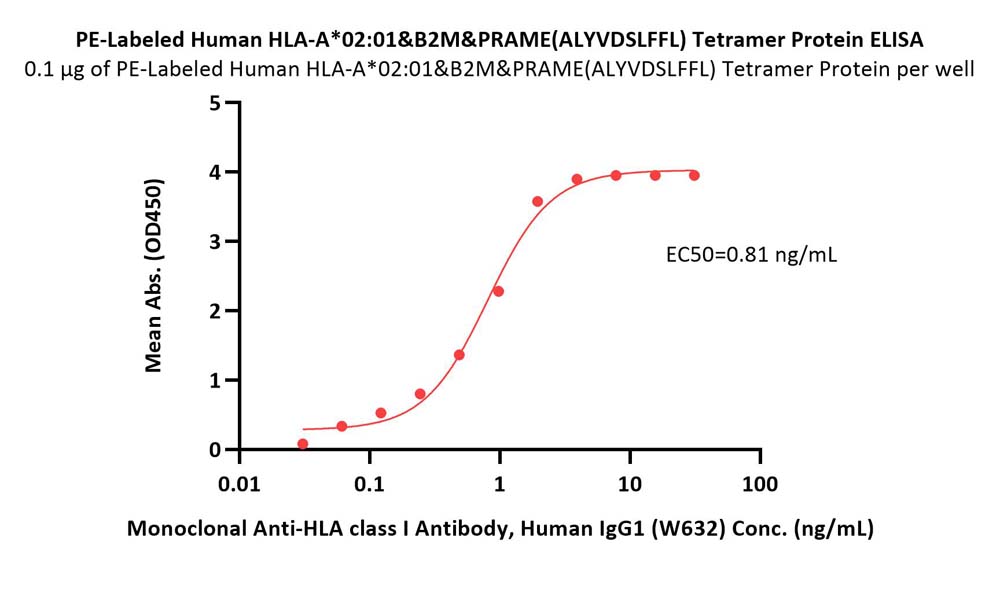
     HLA-A*0201 & B2M & PRAME (ALYVDSLFFL) ELISA

    Immobilized PE-Labeled Human HLA-A*02:01&B2M&PRAME (ALYVDSLFFL) Tetramer Protein (Cat. No. HLE-HP2E3) at 1 μg/mL (100 μL/well) can bind Monoclonal Anti-HLA class I Antibody, Human IgG1 (W632) with a linear range of 0.03-2 ng/mL (QC tested).

    Protocol
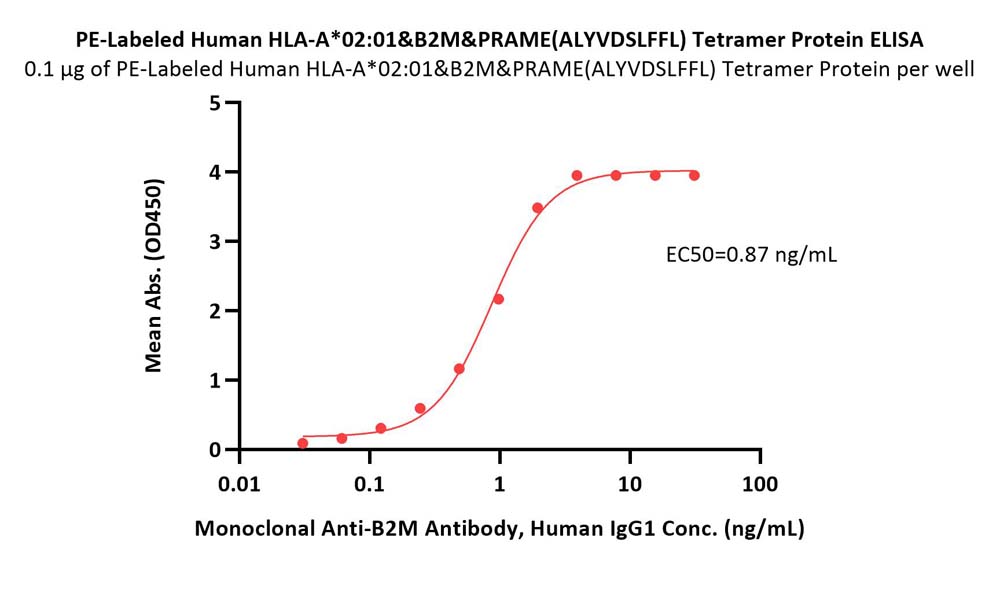
  •  HLA-A*0201 & B2M & PRAME (ALYVDSLFFL) ELISA

    Immobilized PE-Labeled Human HLA-A*02:01&B2M&PRAME (ALYVDSLFFL) Tetramer Protein (Cat. No. HLE-HP2E3) at 1 μg/mL (100 μL/well) can bind Monoclonal Anti-B2M Antibody, Human IgG1 with a linear range of 0.03-2 ng/mL (QC tested).

    Protocol

Customer Reviews
Writing Reviews

FAQ

  • product

    Can lyophilized proteins remain stable during room-temperature shipping or temporary room-temperature exposure?

    In general, lyophilized proteins remain stable during room-temperature shipping or temporary exposure to room-temperature conditions.


    Many ACROBiosystems recombinant proteins are supplied in lyophilized (freeze-dried) form. The lyophilization process effectively removes moisture from the product, helping reduce degradation-related reactions and improve protein stability during transportation and storage.


    To evaluate the stability of lyophilized proteins under normal temperature conditions, ACROBiosystems conducted a stability study on 11 representative lyophilized protein products at 37°C. The study demonstrated that these proteins maintained good quality stability after storage at 37°C for approximately 20 days. Based on these validation results, temporary room-temperature exposure during shipping or handling is generally not expected to have a significant impact on product quality or downstream application performance.


    To ensure optimal long-term stability, products should be stored according to the storage conditions specified in the product Certificate of Analysis (COA) upon receipt.


    Supporting Document


Background

PRAME (Preferentially Expressed Antigen in Melanoma) is a well-characterized member of the cancer/testis antigen family. Functioning as a nuclear receptor and transcriptional regulator, PRAME negatively modulates retinoic acid signaling, thereby regulating tumor cell differentiation and proliferation. It is aberrantly overexpressed in a variety of malignancies, especially cutaneous melanoma, and its upregulation is closely linked to aggressive tumor phenotypes. Given its tumor-specific expression and oncogenic role, PRAME has emerged as a promising diagnostic biomarker, prognostic indicator, and attractive therapeutic target for tumor immunotherapy.

Recent Advances

 
Drug Candidate Licensing
More
  • Basic Product Information
  • Product Details
  • Customers Also Viewed
  • Performance Data
  • Customer Reviews
  • FAQ
  • Background